
I Was Studying Electrical Engineering When I Found This
The two questions I asked that day still open most of my projects
I am Zahurul Islam Zee. Most people just call me Zee.
Most businesses that hire me have already hired well. A designer who made a good page. A media buyer who runs competent campaigns. Somebody who set up the email tool.
What they do not have is anybody responsible for what happens between those things, which is where the money goes.
That gap is what I have spent thirteen years working in, since June 2013.
Two questions asked over somebody's shoulder
- what is this
- why are you doing it
I was at IUBAT studying Electrical and Electronics Engineering when I first saw this work being done.
A senior in my department was building something in Infusionsoft. I had no idea what I was looking at, so I asked him two questions: what is this, and why are you doing it.
He explained what a campaign was and what it was for. Then I asked how somebody gets paid to do that, and he told me about Upwork.
That was the whole beginning. June 2013, a first job on a platform I had heard about a week earlier, in a field I had learned about by asking somebody what was on his screen. I was still an engineering student at the time and stayed one until 2014.
What came after was less interesting and took longer. Courses, seminars, books, and thousands of dollars spent on my own training over the years since. Marketing automation in 2013 was not something you could study anywhere near me, so it got learned the expensive way: buying the material, doing the work, and finding out on live client projects which parts of it were true.
What is this, and why are you doing it. Asked about somebody's funnel rather than somebody's screen, those two questions are usually more revealing than the person expects.
Why an engineering degree turned out to matter
I did not finish an engineering degree in order to become a better marketer. It happened the other way round: the engineering was already there, and it changed how the marketing work got done.
An engineer looks at a system and asks where the current stops. Not which component is prettiest or which one somebody spent the most on. Where does the flow break, and what happens downstream of the break.
That is a strange way to look at a funnel and it turns out to be the correct one.
Most marketing failures are not creative failures. They are continuity failures. A lead enters through one system, gets recorded in a second, and the third one that was supposed to follow up never learns they exist. A webinar platform knows who attended and the email tool does not. A payment fails and nothing downstream is watching.
Nobody designed those breaks. They accumulated, one reasonable decision at a time, and the business only sees the total at the end of the month.
Finding where the current stops is most of what I actually do.
A Master's in New York I have not completed yet
By 2023 I had been doing this for ten years and had built most of what I knew by trial. That is a fast way to learn and a poor way to understand why anything works.
So I went to New York to study Digital Marketing and Media at Yeshiva University.
I did not finish it. Family circumstances brought me home before the degree was completed, and I intend to go back.
Stating that rather than leaving it off is deliberate, and it belongs on a site whose argument is that claims should be checkable. An unfinished degree presented as a finished one is the same category of thing as a revenue figure with no screenshot behind it, and there are several places on this site where I say plainly that a number lacks its evidence.
What I did get from the time there was the layer underneath the tactics. Consumer psychology, media strategy and analytics: why a page order works, why an offer converts at one price and not another, what is actually happening when somebody hesitates. Ten years of practice first and the theory second is an unusual order, and I would recommend it. Learning the frameworks after you have already been wrong in public means you know which parts of them matter.
Strategy, design, build, automation and tracking, on the same engagement
Not because doing everything is impressive. Because the failures are in the seams, and a seam only gets owned when one person is on both sides of it.
On a typical project that means mapping the offer and the journey, designing and building the funnel, writing or restructuring the copy, wiring the automation, connecting the platforms, and setting up the tracking that makes any of it measurable afterwards.
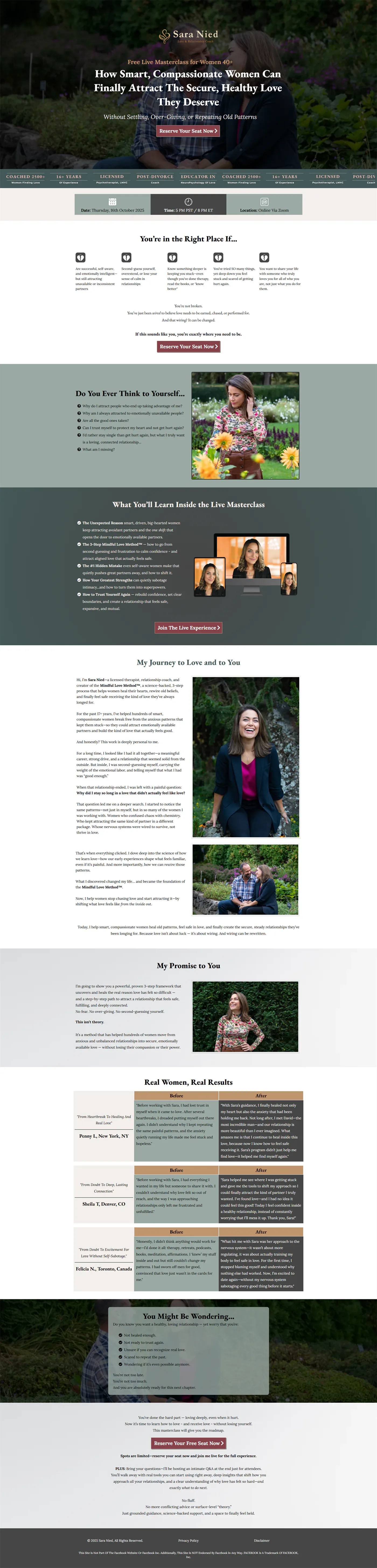
The Sara Nied Coaching build is the clearest example: a migration off Ontraport, four funnels, a website, a sequence per funnel, full automation and Conversions API tracking, all in one engagement. She had run webinars before and sold nothing. The first one on that system sold at $1,497.
The tradeoff is honest. An agency has more hands. If you need five funnels built simultaneously next month, hire one. What you get here instead is that nobody has to explain anything to anybody, and nothing falls between two people's definitions of their job.
Thirteen years, and where the work actually came from
- from June 2013
Upwork
Where this started. 178 jobs, 1,562 hours, and a 100% Job Success Score with Top Rated status by the time I stopped taking work there.
That is only part of the picture. From 2016 onward most of the work came from outside the platform, and that side accounts for another 350 or so engagements.
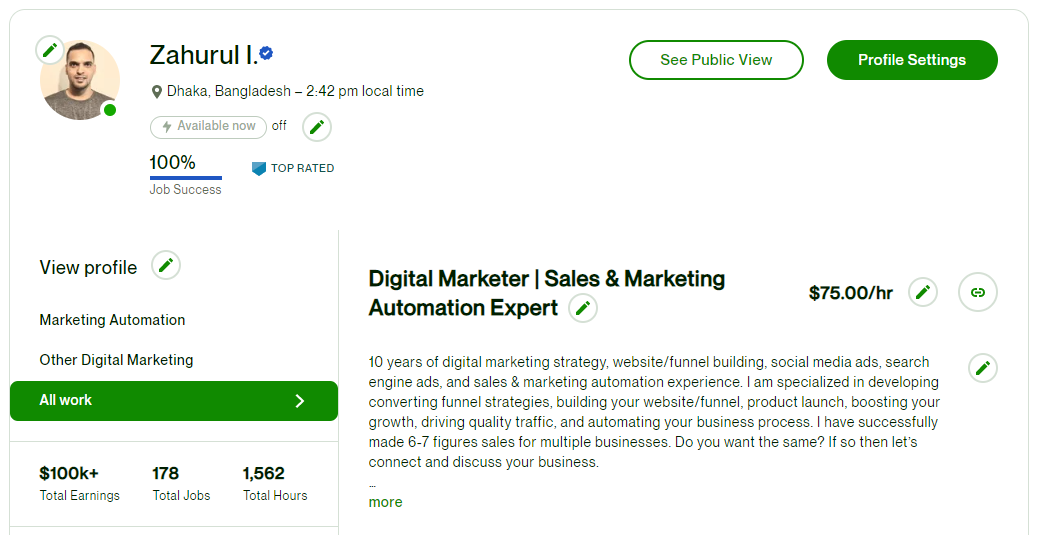
Upwork profile: 178 jobs, 1,562 hours, 100% Job Success Score, Top Rated
- March 2017 to today
Mike Zeller
Nine years, and still running. It began as a full-time engagement through Elevate United and became a long-term project partnership: six funnels across life coaching, business strategy and health, including a nine partner JV launch and a book funnel still selling three years after it was built. Longest relationship in the portfolio, by a distance.
- 2020 to 2021
PPC Boutique
Ten months as Senior Funnel Strategist, managing high ticket accounts in the coaching and education space. RAL Academy, where the attribution layer tracked $7M. Multifamily Movement, where an evergreen webinar ecosystem produced $2,246,155 in twelve months. Noteschool, a full funnel and automation build.
Three seven figure funnel systems inside ten months, which is the densest period of work in thirteen years.
- September 2019 to November 2020
Enriched Academy
Fifteen months as Marketing Tech and Automation Manager for a Canadian finance education brand. Not a freelance engagement: an in-house role covering funnel architecture, automation and coordinating freelancers. Two separate funnels each produced six figures.
- three months in 2021
ClinicGrower
System Engineer at a growth provider for medical and aesthetic practices, alongside PPC Boutique.
The job was onboarding new practices onto a working system. Each one meant a funnel built to their standard operating procedure, automation, forms, surveys, payment gateway, domain connection, product setup, and Facebook and Google ads data flowing into the right places. Everything wired together with Zapier and running on GoHighLevel.
The largest single integration there ran to around 42 steps. That is not a boast about complexity, it is the opposite: a 42 step integration exists because a business has forty two places where something has to happen and nobody has connected them yet. Doing that repeatedly, at speed, for practice after practice, is where I learned what actually breaks in a system that has to be handed to somebody else and left running.
Elevate United, Vevazz, Firespoke Digital Media
Three earlier roles between 2016 and 2019, covering marketing direction, paid media and funnel architecture for agencies and product companies. This is where the full stack got built: strategy, ads, automation, analytics and copy, learned by being responsible for all of them at once rather than by choosing one.
- May 2024 to today
Marketer Zee
The independent consultancy, and everything on this site since.
- 300+
- funnels and websites
- 150+
- tools
- 20+
- countries
Two of the twenty three projects on this site came through an agency, both at PPC Boutique, and both case studies name it. One came through an in-house role at Enriched Academy. The rest were direct.
That distinction is drawn here because a portfolio that blurs agency and employed work into direct client work is doing something dishonest quietly.
500+ covers everything since 2013: 178 jobs on Upwork, roughly 350 more from direct work outside it since 2016, plus the agency and in-house roles above.
Four things worth knowing before you get in touch
- I will tell you if the problem is somewhere else.On more than one project the honest answer was that the funnel was fine and the issue was upstream of it. That conversation is cheaper for both of us than a build that was never going to fix anything.
- Nothing gets built before the mapping is agreed.Changes at that stage cost minutes. Changes after the build cost weeks. It is the least exciting part of any project and it decides most of the outcome.
- Numbers get stated the way they actually are.Where a figure came from a client rather than from an account I could see, the case study says so. Where a total has no screenshot behind it, it says that too. There are examples of both on this site, and they are there on purpose.
- Handover is included.Documentation of what was built and how it runs, so your team can change things without booking a call. A system only its builder can maintain is a liability with good open rates.
Remote since the first day, across 20+ countries
This started on Upwork in June 2013 and has been remote ever since. Not as an adjustment to anything, and not as a compromise. It is simply how thirteen years and 500+ clients across 20+ countries have been done.
Which turns out to suit the work. Funnel building is long stretches of focused construction punctuated by decisions. It is not a job that improves by having two people online at the same time.
Calls happen when they suit you. Clients are in the US, Canada, the UK, Australia and Europe, and have been for over a decade. Scheduling across time zones is a solved problem in this business.
Most of the build is asynchronous, deliberately. You get the decisions to make, and I get the hours to build without interruption. That is faster than the alternative, not slower.
No shoots and no on-site work. Where a project needs original photography or video of you, you or a local photographer capture it and I build everything around it. That is stated plainly on the creative production page rather than discovered mid-project.
Payment terms are the same for everybody. 50% upfront, balance on delivery, every project.
A 100% Job Success Score across 178 jobs and 1,562 hours is the record behind that.
What I build on
- Funnels and sitesGoHighLevelClickFunnelsKajabiKartraWordPressDropfunnelsLeadpagesUnbounce
- CRM and automationGoHighLevelActiveCampaignOntraportKeapHubSpotZapierMake
- WebinarsWebinarJamEverWebinarStealthSeminarZoom
- TrackingMeta Pixel and Conversions APIGoogle Ads conversion trackingGA4Google Tag Manager
- AdsMetaGoogleand the platforms a campaign needs
150+ tools across thirteen years. The ones above appear in case studies rather than on a list of logos. Which platform a project runs on gets decided by your offer and your team, not by what I find easiest to build in.
Everything Here Is An Argument For That One Sentence
Thirteen years of this has produced one consistent finding, and it is on every page of this site.
The money is rarely lost where the business thinks it is.