
Nine Partners, Nine Funnels, One System
Mike Zeller, Abundant You Challenge
$117,472 across the full funnel, from a $5 front end offer
- Client
- Mike Zeller, coach, consultant and author
- Vertical
- Personal development and coaching
- Entry offer
- Abundant You Challenge, $5
- Result
- $117,472 across the full funnel, from a $5 front end offer
- Period
- 2021 to 2024
- Transactions
- 1,663
- Funnel steps
- Around 78, including nine complete partner paths
- JV partners
- Nine, each with their own branded funnel and tracking link
- Attribution
- Full affiliate system in ClickFunnels, one tracking link per partner
- Stack
- ClickFunnels
- Traffic
- Direct and partner, running alongside each other
- My role
- Direct client. Funnel design, conversion structure, affiliate system, automation and system integration, the same scope as the other Mike Zeller funnels
A JV launch has nine audiences, not one
The offer was a $5 challenge. Low enough that almost anybody could say yes, which is the entire point of an offer at that price.
What made this different from the other funnels built for Mike Zeller was that it had to serve two kinds of traffic at once.
Mike promoted it to his own audience, the way the event funnel and the course launch were promoted. Alongside that, nine joint venture partners promoted it to theirs, several of them well known names in personal development.
Direct traffic and partner traffic ran in parallel throughout, and the sales came from both.
That combination creates a problem a single audience launch never faces.
Somebody arriving from a partner's list is warm to that partner. They trust them, they opened their email, and they clicked because that person vouched for something. They may never have heard of Mike Zeller. Send them to a generic sales page and the recommendation they arrived on is dropped at the door.
Send all nine audiences to the same page and eight of them are being spoken to by somebody else's brand. The partner did the hardest part of the work, and the page wastes it in the first three seconds.
There is a second problem underneath it, and it is the one that decides whether partners promote again.
Partners need to see their own numbers, and they need to see them without asking. A single shared funnel makes attribution a conversation, then a disagreement, then a reason not to take part next time. Nobody says that out loud. They just decline the next launch.
That is expensive in a way that never appears in a report, because the cost is the promotion that did not happen.
What I built
- A core funnel for direct traffic
Sales page, checkout, three upsells and separate thank you pages for VIP and non-VIP buyers. This is the path Mike's own audience took, and it works on its own without any partner involvement.
- Nine complete funnel paths on top of it, one per partner
Each partner has their own opt in page, order page, three one time offers and order confirmation. Not a shared page with a swapped logo. A separate path, so somebody arriving from a partner meets something that acknowledges where they came from and carries that through to the confirmation screen.
Nine partners at six pages each, plus the core funnel and its variants, is around 78 funnel steps in one system.
- A full affiliate system with a tracking link per partner
Set up inside ClickFunnels, with a separate tracking link for each of the nine. Every sale attributed to the partner who sent it, automatically, visible to them rather than reported to them.
That removes the conversation entirely. A partner does not have to trust a number somebody sent them, because they can see it. On a launch where nine people are choosing whether to mail their list for you, being the one who makes their reporting easy is worth more than anything on the sales page.
- A price ladder from $5 to $997
Step Price Abundant You Challenge $5 Order bump $10 total Abundant You 33 Day Journal $24 VIP Ticket $97, later $147 Zone of Genius Bonus $197 Abundance Academy $797, later $997 Payment plans on the Academy 2 payments of $598, or 3 of $348 Roughly two hundred times the entry price at the top, reached through a sequence of small decisions rather than one large one.
- Three one time offers per path
Challenge, then journal, then the larger program, presented immediately after each purchase, in the window where the decision is already made and the card is already entered.
- Separate VIP and non-VIP routes
A VIP upgrade with its own checkout, its own thank you page and its own confirmation, running alongside the standard path rather than bolted on.
- Supporting funnels in the same system
A standalone journal sales page with its own confirmation, a pledge opt in, a friend ticket opt in, a five disciplines lead magnet, and a full Abundance Academy sales path including a mastermind order page.
- Payment plan handling
Two and three payment options on the Academy, tracked as recurring rather than as single transactions, so the reporting reflected what was actually collected.
The funnel, step by step

Sales page
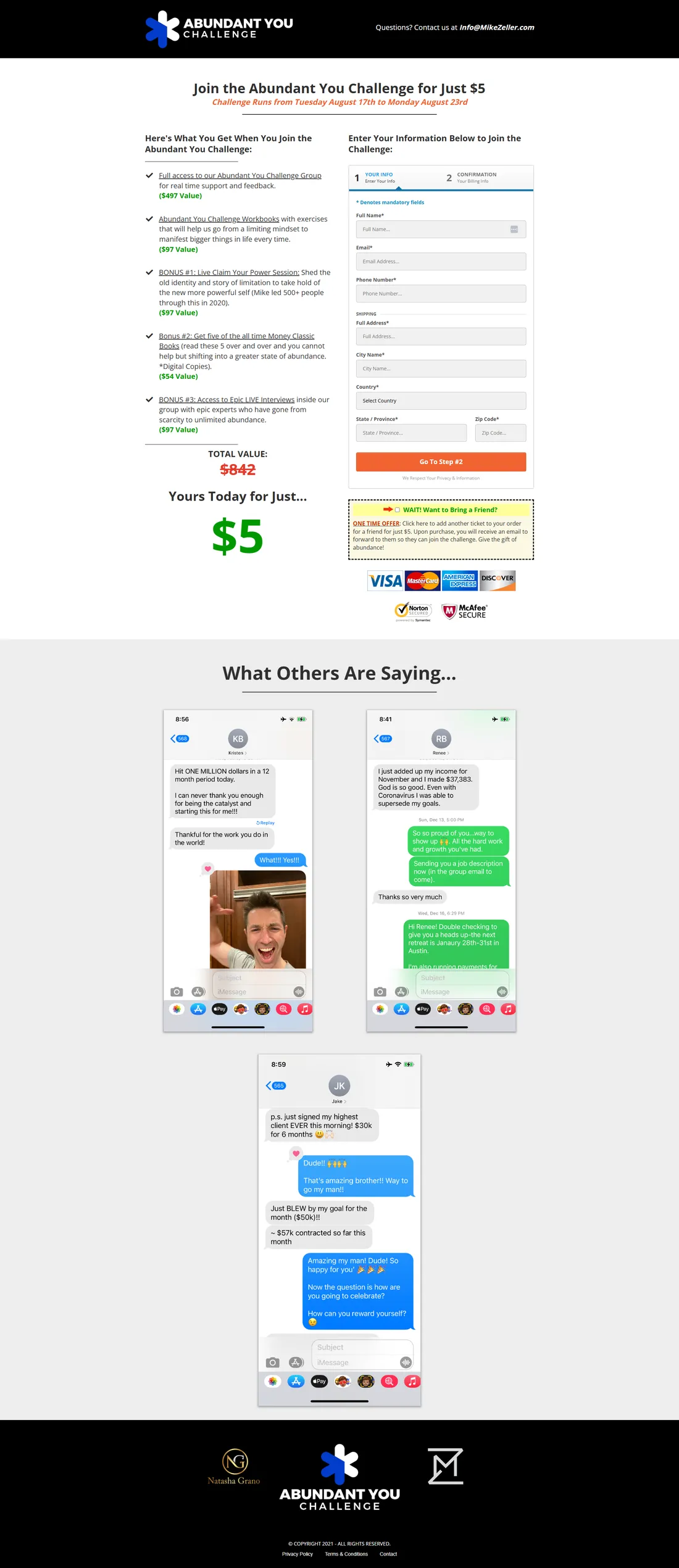
Checkout
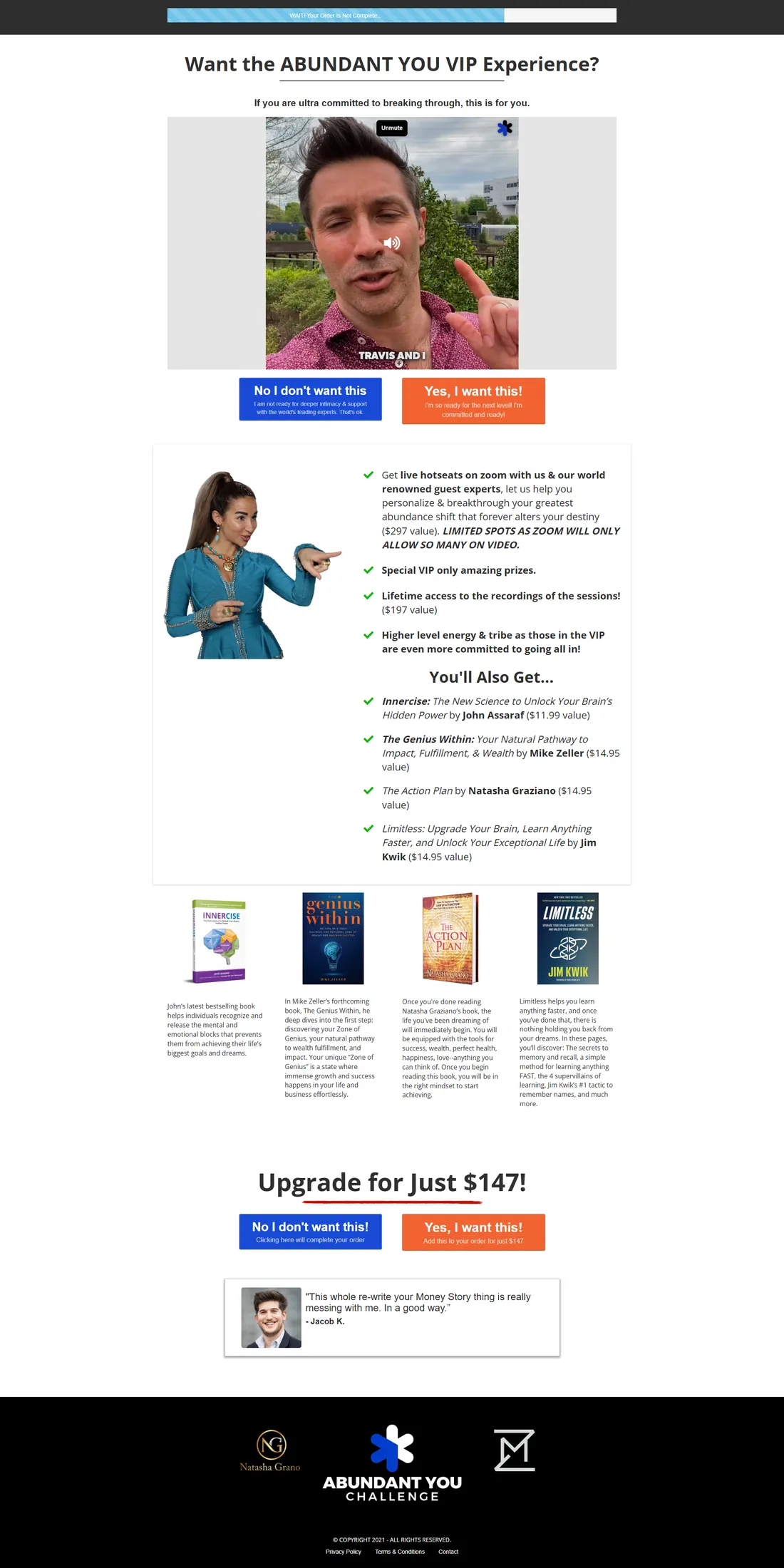
OTO 1

OTO 2
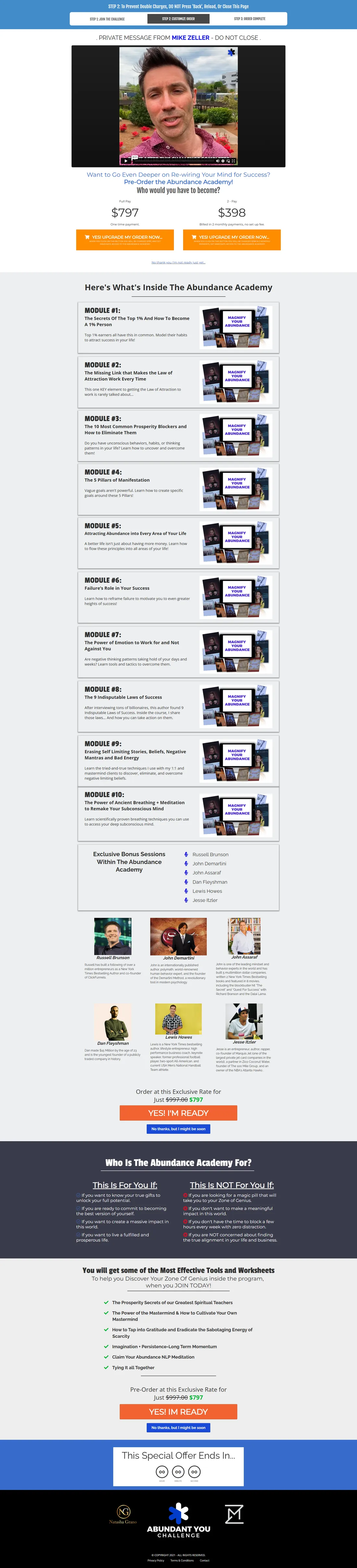
OTO 3
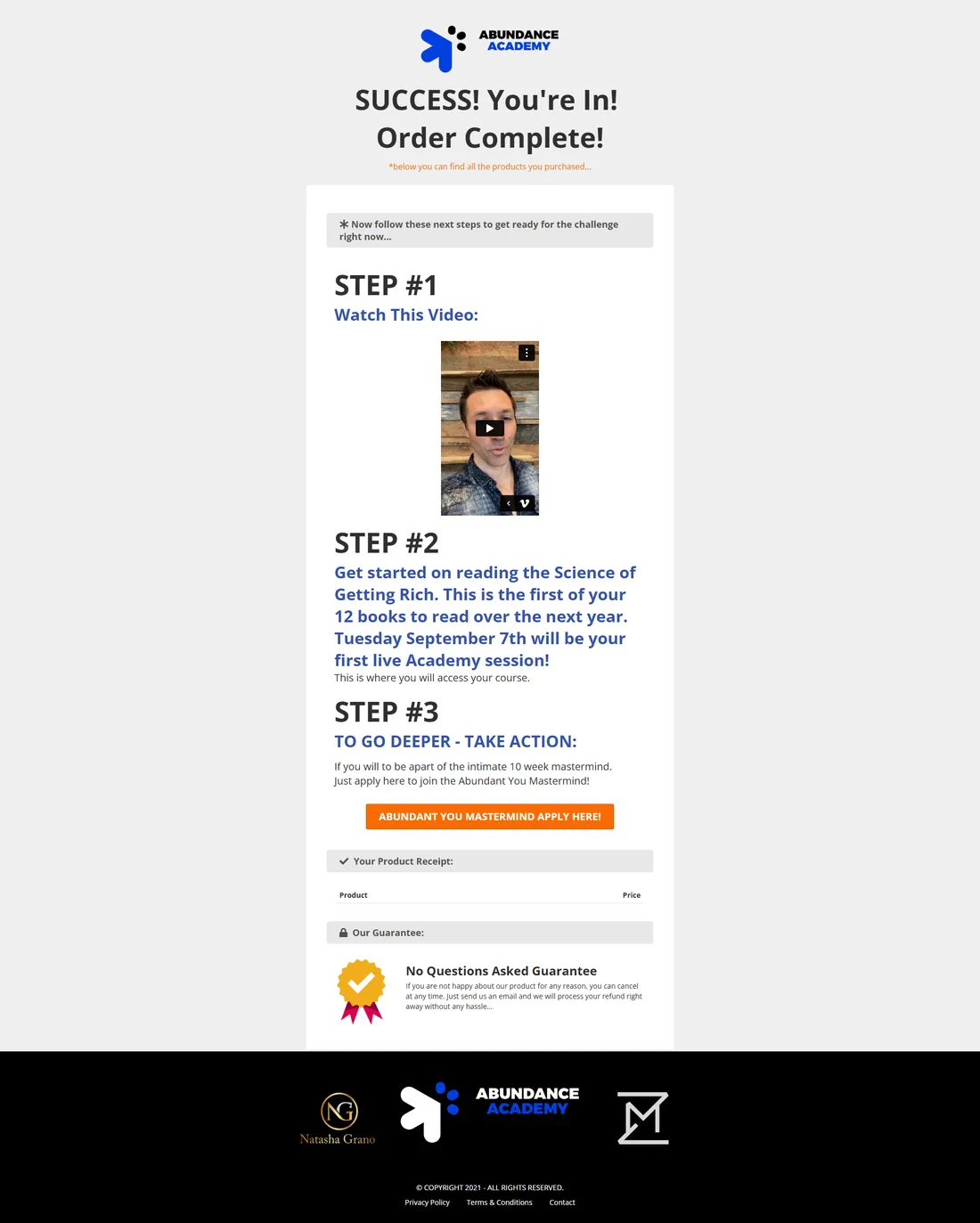
Order confirmation
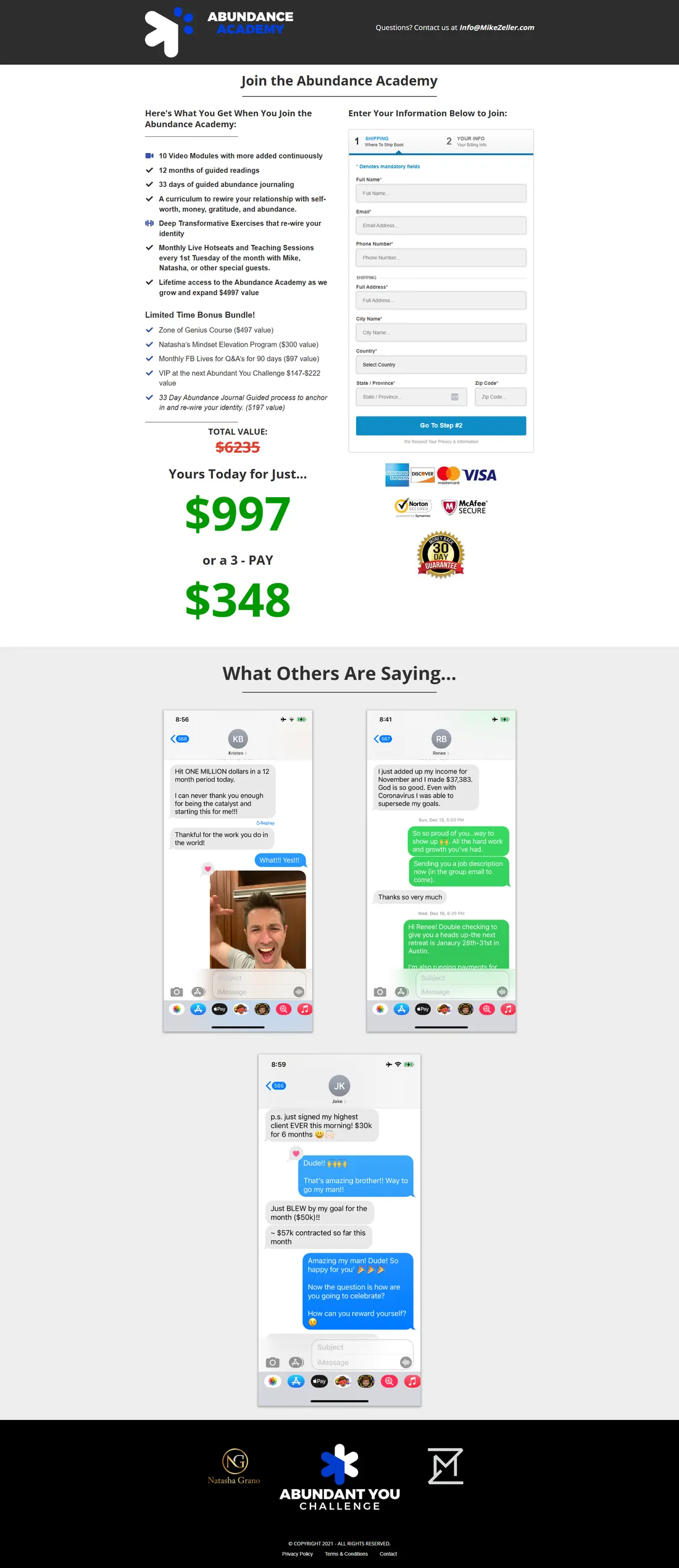
Abundance Academy pre-sell checkout
What it produced
$117,472 across the full funnel, from a $5 front end offer, over 1,663 transactions between 2021 and 2024.
That figure covers everything: the $5 challenge, the order bumps, the journal, the VIP tickets, the Zone of Genius bonus and the Academy at $797 and $997. It is the ladder total rather than the front end.
The ratio is the thing worth reading. An offer priced at $5 produced six figures, and it did so because almost nobody stopped at $5. The transaction log shows individual customers appearing repeatedly: the challenge, then the journal, then a VIP ticket, then in some cases the Academy at $797 or $997.
That is what a ladder does when the rungs are close enough together. Each step is a small decision made in the moment after the previous one, and the distance from $5 to $997 gets covered without anybody being asked to make a $997 decision.
The partner structure is what made the volume possible. Ten audiences in total, counting Mike's own, each arriving through a path built for them rather than through a shared page written for a stranger.
The attribution held across the whole ladder rather than only the entry sale. A partner who sent somebody in at $5 was credited when that person later took the journal, the VIP ticket or the Academy, which is what makes promoting a $5 offer worth a partner's time in the first place.
Three years is the other number worth noticing. This was not a launch that spiked and stopped. It ran, and kept running, across 2021 to 2024.
What applies to a business like yours
Three questions worth asking if partners or affiliates send you traffic:
- Does somebody arriving from a partner see a page that acknowledges who sent them, or a page written for a stranger?
- Can each partner see their own numbers without asking you for them, and is every sale in the ladder attributed to them or only the first one?
- If your entry offer is $5, what is the largest amount a single customer has ever spent with you in one session?
The third question is the one that tells you whether you have a ladder or just a cheap product.
Services behind this project
- Website & sales funnel design
- Marketing strategy
- Marketing automation
- Creative production
- Conversion tracking and attribution
The thinking behind this project: Your front end offer is not where the money is
Neither Number Works Without The Other
Mike sold to his own audience and nine partners sold to theirs, each through a path that looked like where the buyer had come from. A $5 offer became $117,472.
Neither of those numbers works without the other.