
Your Front End Offer Is Not Where The Money Is
Nineteen people bought a course. That produced $7,243.
Eleven of those same people went on to buy something else in the minutes and weeks that followed, and that produced $23,445.
Same list. Same launch. Same traffic. Three quarters of the revenue arrived after the front end sale, and the only reason it did is that somewhere existed for those buyers to go.
Why do most course funnels end at the thank you page?
Almost every course business puts its attention in the same place. The price of the main offer, the sales page, the launch emails, the webinar that sells it.
Then somebody pays, and the funnel effectively stops. A thank you page. An onboarding email. Nothing else on offer until the next launch, which might be three months away.
That is the most expensive habit in the category, and it is expensive in a way that never shows up as a problem. Nobody looks at a launch report and sees the money that was not offered. Revenue that did not happen leaves no trace, so the gap persists for years without anybody identifying it as a gap.
What does a 26% upsell take rate look like?
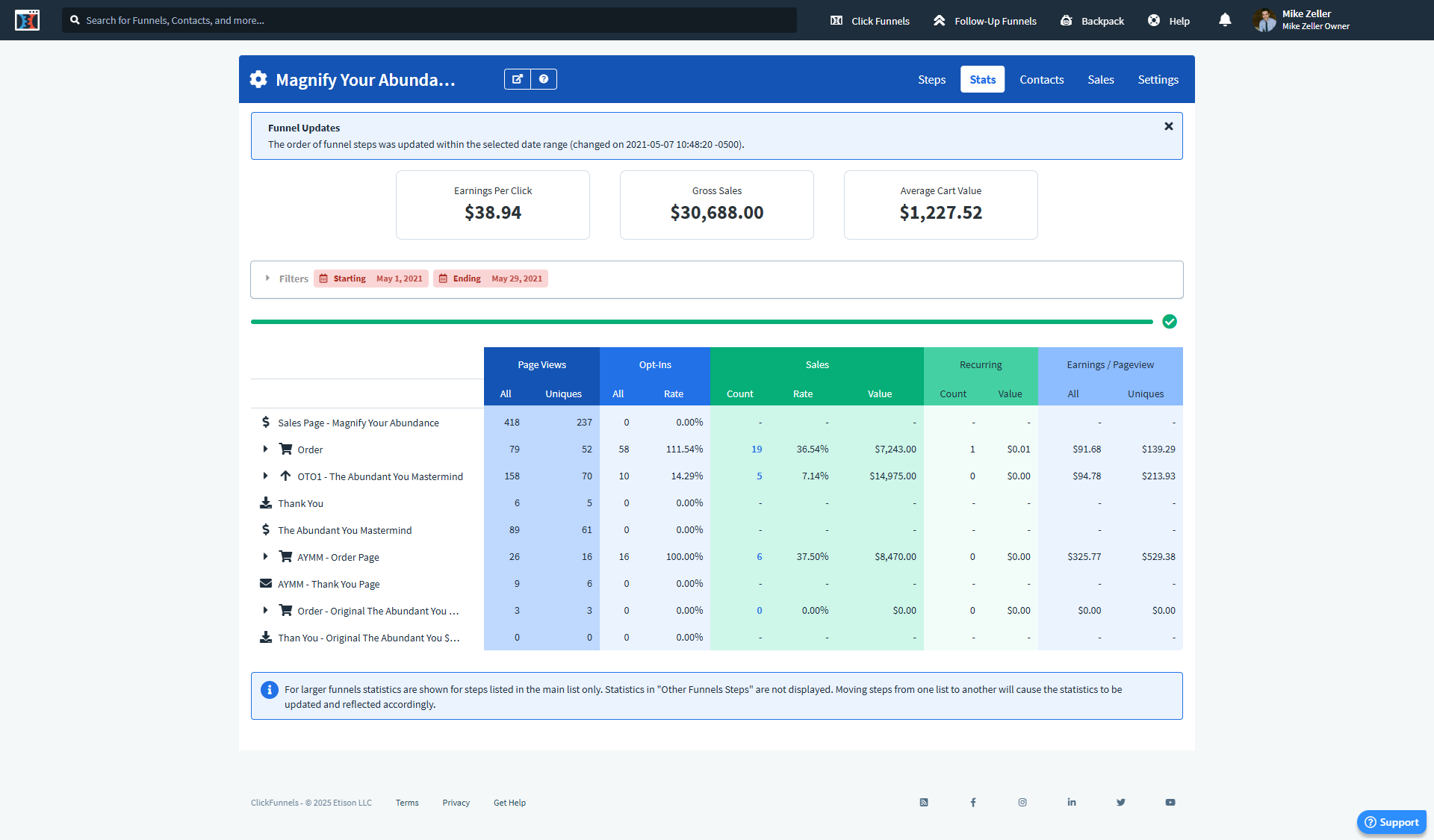
The project was a funnel for Mike Zeller, selling a course pre-order at $597 with a mastermind at $2,995 sitting above it. It ran to a list of about ten thousand people, with no paid traffic, over twenty nine days in May 2021, built on ClickFunnels with ActiveCampaign behind it.
| Sales | Value | |
|---|---|---|
| Course pre-order | 19 | $7,243 |
| Mastermind, taken as a one time offer | 5 | $14,975 |
| Mastermind, second path | 6 | $8,470 |
| Total | $30,688 |
Two figures inside that are worth pulling out.
Of the nineteen people who bought the course, five took the mastermind immediately. That is a 26% take rate on a one time offer, at a five times price jump, in the moment right after purchase.
The average cart value was $1,227.52 on a $597 offer. The average buyer spent roughly double the advertised price. Not because anybody was upsold aggressively, but because a second thing existed and they saw it at the right moment.
A word on treating 26% as a benchmark. It is not one. Take rates move with the price gap and with how obviously the upsell follows from the purchase, so a single number from a single funnel is not something to measure yourself against. A smaller price jump usually converts higher and produces less revenue per buyer, which is the trade being made every time somebody prices an upsell.
Why do upsells convert better than a separate launch?
The temptation is to explain a 26% take rate with something about persuasion. It is not that.
It is timing, and the timing is unusual in a way that does not repeat.
Somebody who has just paid is in a state they will not be in again for weeks. The decision is fresh. The hesitation they had, whatever it was, has already been beaten by their own action. The card details are already entered. And they have just told themselves, through what they did rather than what they thought, that this is the sort of thing they buy.
Try to reach that same person a month later with the bigger offer and none of those conditions hold. They are back to being undecided, the card is put away, and the email arrives among forty others.
The default approach, launching the second offer separately a few weeks later, misses that window entirely. It also sells the second offer to a list that has just been mailed hard, which is the worst possible moment to ask again.
How do you sell a $2,995 offer to somebody who just paid $597?
$597 to $2,995 is a five times jump.
Presented as a separate launch, that is a hard sell to almost everybody. The prospect has to re-decide from scratch, at a price point most of them have never spent with you.
Presented immediately after a purchase, to somebody who has just demonstrated they want what you are offering, it stops being the same question. They are not deciding whether to trust you. That part is settled. They are deciding whether they want more of a thing they have just chosen.
A payment plan on the upsell helps for the same reason. $2,995 in one payment and $2,995 across installments are different decisions, and the difference matters most in the seconds after somebody has already spent $597.
The upsell does not have to be more expensive, though it usually is. What matters more is that it is the obvious next thing for somebody who just bought, rather than a different product aimed at a different need. A cheaper add on that completes the purchase can outperform a larger offer that changes the subject.
One worry worth putting down: adding an upsell does not cost you front end conversions. It appears after the purchase, not before it. What does cost you conversions is putting a decision in front of the checkout, which is a different mistake with a similar name.
Does this apply outside course businesses?
The pattern is not specific to courses or to one time offers.
Book funnels. A free plus shipping book loses money on its own. That is the model, not a flaw in it. On another Mike Zeller project the ladder above the book ran $9.95 shipping, then a $47 toolkit, then a $297 course, then a $697 one to one session. Seventy times the entry transaction, reached by a series of small decisions. It is still selling three years later.
Memberships. Somebody joins on a trial. What happens during the trial decides whether they stay, and most trials expire in silence.
Service businesses. A client finishes a project. That is the moment they are most likely to buy the next one, and the moment most consultants say thank you and go quiet.
In every version the question is the same. What exists on the other side of a yes.
How many is enough is a fair question and the answer is unsatisfying: enough that a buyer has somewhere to go, few enough that they are not still being sold to four screens after paying. Three is common. The book funnel above uses three.
How do I know if my funnel has this problem?
Three questions, and the third one gives you a number.
1. What is the first thing a buyer sees after their payment goes through?
If the answer is a thank you page and nothing else, the funnel ends at the point where the buyer is most willing.
2. If you have an offer above your main one, when do buyers hear about it?
If the answer is "in a few weeks" or "at the next launch", you are reaching them at the worst moment rather than the best.
3. What is your average cart value compared with your headline price?
If those two numbers are the same, nothing exists after checkout. That is the whole diagnosis and it takes a minute.
Asked At The Only Moment When Asking Works
Nineteen people bought a course. Eleven of them went further, and that is where three quarters of the money came from.
The eleven were not persuaded by anything clever. They were asked at the only moment when asking works.
If your funnel ends at the thank you page, that is usually the cheapest revenue available to you.