
A Launch Earns Once. A Ladder Keeps Earning.
The oldest transaction in that funnel's sales log is over three years old. The newest is from last week.
Nobody launched anything in between. Nobody presented, emailed a list, or opened a cart. The funnel was built once and it has been selling ever since, through a platform migration and several years of the business changing around it.
What is wrong with running a launch business?
Nothing, until it is the only thing.
Launches work. They concentrate attention, create real deadlines, and produce revenue in a window you can plan around. Every business on this site has run them.
The problem is what happens between them. Revenue arrives in spikes with flat months in between, so the business is either launching or waiting. And because the list is the asset that makes launches work, it gets mailed hard every few months and slowly stops opening.
That produces a specific trap. The answer to a disappointing launch is usually another launch, which needs a bigger list, which needs more acquisition, all of which is expensive and none of which fixes the underlying shape.
What does an evergreen ladder actually look like?

One example, from a funnel built for Mike Zeller.
The entry offer was his book, given away free with the buyer paying $9.95 shipping. Above it sat three upsells: a $47 workbook and video training toolkit, a $297 course, and a $697 one to one session.
Seventy times the entry transaction at the top rung, reached by a series of small decisions rather than one large one. Each upsell presented immediately after the previous purchase. Separate confirmation pages depending on what somebody had taken, because a buyer who took two upsells needs to see something different from one who took none.
347 transactions to date. Six figures in total sales. Fourteen funnel steps, including a second workshop funnel and a waitlist. Built on ClickFunnels, later migrated onto GoHighLevel with its buyer history intact, and still running.
Does free plus shipping make money?
Not on its own, and that is the model rather than a flaw in it.
You give the book away, you cover shipping and not much else, and what you buy for that cost is a list of people who have proven they will enter payment details. Somebody who has paid you anything, even $9.95, is a fundamentally different prospect from somebody who downloaded a PDF.
The economics only work if something exists above it. Most people build the front end and stop, and six months later the business has a lot of $9.95 transactions and no idea why the numbers do not add up.
The front end was never supposed to be the business. It is the door.
Can a webinar be evergreen without converting worse?
Yes, and the gap between a replay and a live session is smaller than most people assume once the machinery around it exists.
The usual objection is fair on its face. A replay with no reason to attend at a particular time and no consequence for missing it is a video, not an event, and it converts like a video.
What closes that gap is everything around the replay: scheduling that creates a reason to attend now, reminders that behave as though something is happening, pages before the session that prepare somebody to attend rather than just confirm a registration, and follow up that reacts to what a person did.
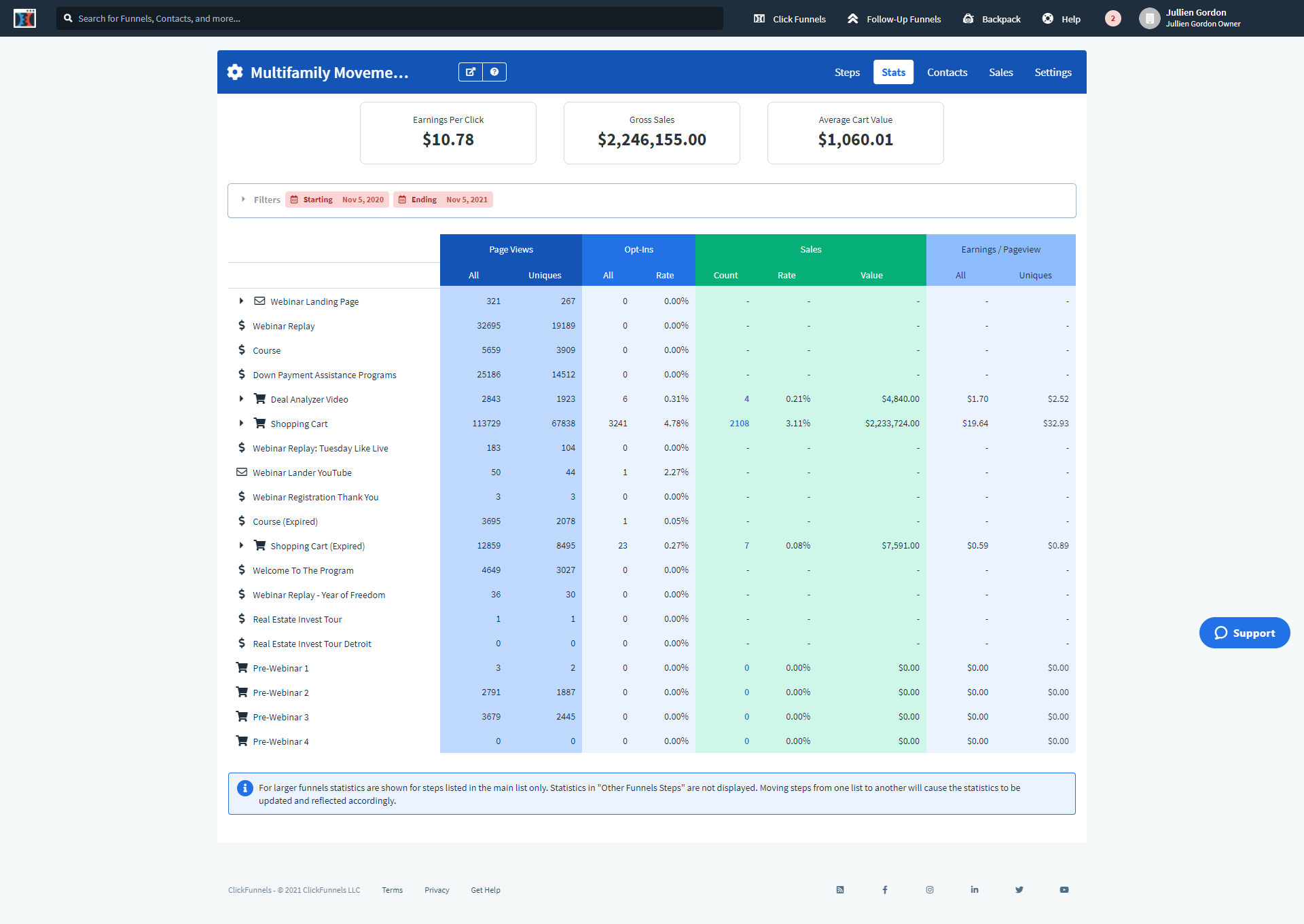
On a real estate coaching business, an evergreen ecosystem built that way produced $2,246,155 across twelve months, from 2,108 buyers at a $1,060 average cart value. The funnel carried four pre-webinar pages and several replay variants, including one scheduled to run "Tuesday like live".
The comparison inside that account settles the question. Over the period, the live landing page took 321 page views. The replay pages took 32,695. The evergreen system was not a supplement to live webinars. It was the business.
Should I stop launching then?
No. The two do different jobs and the businesses doing best have both.
Launches produce spikes, urgency and the concentrated attention that sells high ticket offers. The ladder produces the floor underneath them: revenue on the days nobody is launching anything, from traffic the business was getting anyway.
Mike Zeller has both, built on the same stack. Two launch funnels producing $27,000 in a day and $30,688 in a month, and an evergreen ladder that has been running for three years. Neither replaces the other.
What makes the ladder possible is not the front end offer. It is having somewhere for a buyer to go after they say yes the first time.
How do I know if I need this?
Three questions, and the third one gives you a number.
1. What did your business earn in the last month you did not launch anything?
If the answer is close to nothing, every month is either a launch or a waiting month.
2. If you have a low ticket product, what does a buyer see in the sixty seconds after they buy it?
If nothing, the entry offer is a cost rather than a door.
3. What percentage of last year's revenue arrived outside a launch window?
That number is the honest measure of how much of your business runs without you pushing it.
Build The Thing That Works On Quiet Weeks
The oldest transaction in that log is over three years old and the newest is from last week.
Nobody has launched anything in between. That is the whole argument.
If your business only earns during launches, the gap between them is where the work should go.