
Cohort Businesses Rebuild The Same Pages Every Intake. These Ones Update Themselves.
Your Parenting Mojo
Around one in ten written off payments came back
- Client
- Your Parenting Mojo, founded by Jen Lumanlan
- Vertical
- Parenting education
- Engagement
- Roughly three months, before any ad work began
- Built
- Dynamic cohort funnel pages, funnel redesigns, conditional membership access, dashboard reporting fixes, recovery and operations workflows
- Stack
- Ontraport, Zapier, Slack, Asana, ClickUp, Bonjoro
- Recovery
- Around 10% of failed payments recovered, as of when I last worked on the account
- My role
- Direct client. Funnel design, website work, automation and integration
Automation existed. It just did not join up.
Your Parenting Mojo sells parenting courses to an audience built through a podcast and years of research based content. The courses run as cohorts: Setting Limits and Taming Your Triggers, each with an open date, a close date and a period in between where nothing is for sale.
There was automation already. It worked in the sense that things fired. It did not work in the sense that it behaved as one system, and it could not do the things the business actually wanted.
The clearest example is the cohort problem, and every business selling this way has it.
A cohort funnel page has to say different things at different times. Open for enrollment now. Closing on Friday. Closed, join the waitlist. Next intake in March. Most businesses handle that by editing the pages every cycle, which means somebody is manually rewriting the same pages several times a year, and it means the pages are wrong for the days nobody got to them.
Then there is what happens after somebody joins. A cohort member should see the material for their cohort, not for the one that ran last spring. Without conditional access, that is either a manual job or a compromise.
And underneath both, the reporting was not telling the truth. The Ontraport dashboard metrics were wrong, which meant every decision made from them was made on bad numbers.
What I built
- Dynamic cohort content on the funnel pages
The Setting Limits and Taming Your Triggers pages change their own content depending on where the cohort is in its cycle. Open, closing, closed, waitlist. Nobody edits a page when an intake opens or closes.
This is the piece that made everything after it possible. A page that is always correct is a page you can point paid traffic at without checking the calendar first.
- Both funnels redesigned
Not just repaired. The Setting Limits and Taming Your Triggers funnels were rebuilt, and they are the funnels the ad campaigns later pointed at.
- Conditional membership access
Ontraport based access rules so members see the material for their cohort rather than everything or the wrong thing. Enrollment and access became the same event instead of two.
- Ontraport dashboard reporting fixed
The metrics were wrong. Correcting them mattered more than it sounds, because a business making decisions from a broken dashboard is making them confidently in the wrong direction.
- Failed payment recovery across four tools
A declined payment in Ontraport triggered a Zapier workflow. That created a task so a person knew it had happened, and triggered a Bonjoro request so the follow up went out as a personal video from the founder rather than as a dunning email.
The customer with the expired card receives a short video from the person whose podcast they listen to, saying their payment did not go through and here is how to fix it. That is a fundamentally different message from an automated notice with a payment link, even though the underlying event is identical.
- Operations workflows
Zapier connecting Ontraport with Slack, Asana and ClickUp, so what happened in the marketing system reached the people who had to act on it. A payment failure, an enrollment, a support trigger. Events that previously lived in one platform and needed somebody to notice them.
The system, drawn
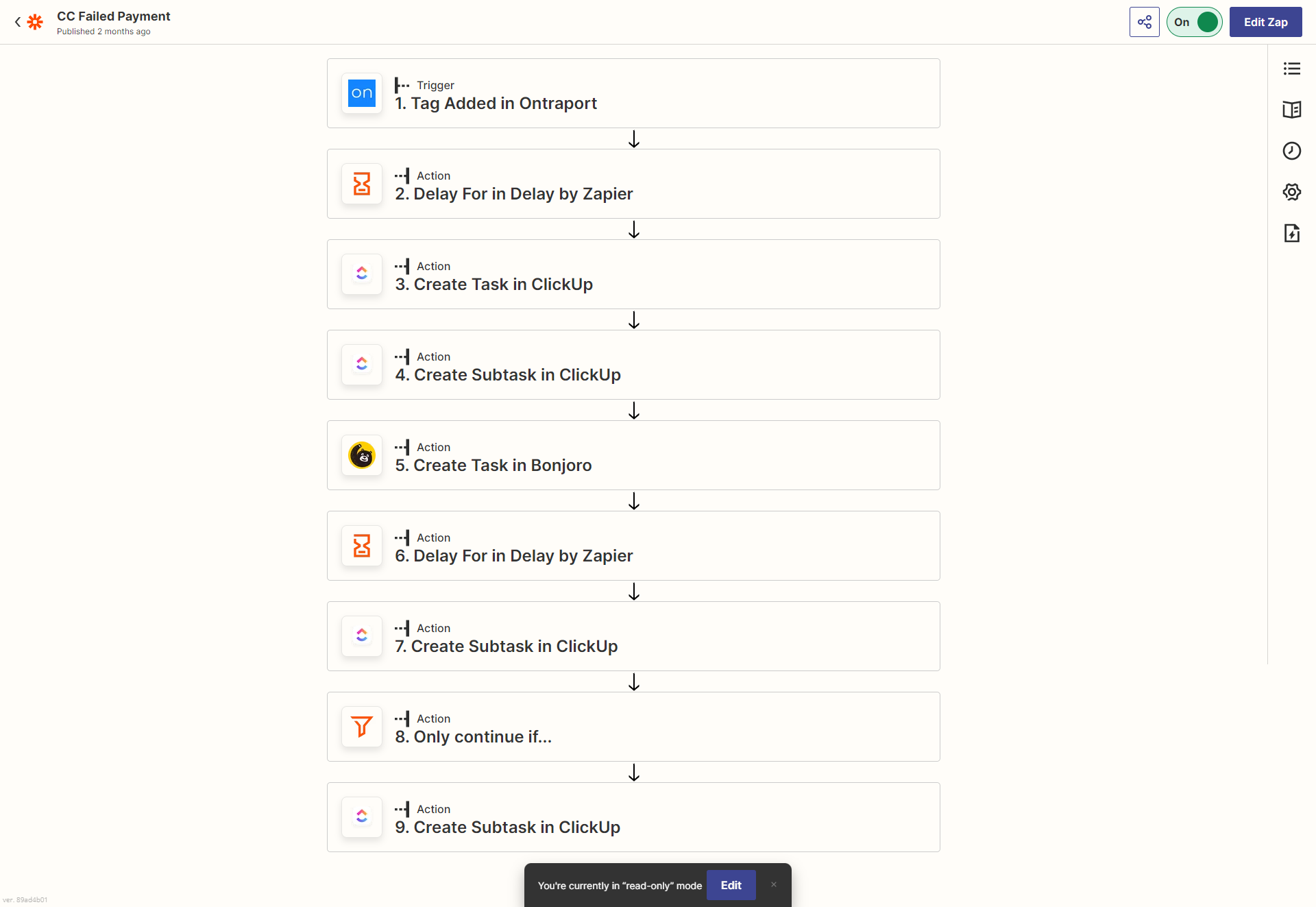
Zapier workflow
What it produced
A funnel that no longer needs editing every cycle. The cohort pages update themselves. That removes recurring manual work and, more importantly, removes the window where a page is wrong because nobody had got to it yet.
This is the one piece of the project with no screenshot behind it, and the reason is worth stating: showing it would require the same page captured twice, once with an intake open and once with it closed. The business has since redesigned its website, so those captures no longer exist and cannot be taken. The workflow structure is documented; the two states are not.
Around one in ten failed payments came back. That figure is worth reading carefully. It is not ten percent of subscribers and it is not ten percent of revenue. It is ten percent of the payments that were already gone: transactions the business had written off, from customers who had not chosen to leave and were not going to be contacted about it. On recurring revenue that compounds, because a recovered subscriber does not pay once.
Reporting that could be trusted. Fixed dashboard metrics, which is the least visible item on this page and the one every other decision depended on.
A foundation the ads could run on. Three months of this work happened before any campaign started. The two campaigns that followed returned 4.57x and 6.18x, pointing at these funnels. Part of the reason they worked is that the destination already did.
On the source of the recovery figure. Around 10% is my recollection from the period I was working on the account, not a report I can produce. The mechanism is what the screenshots show; the recovery rate is what I remember.
What applies to a business like yours
Three questions worth asking if you sell in cohorts or run subscriptions:
- When an intake opens or closes, does somebody edit your pages by hand?
- What happens when a customer's card is declined? Not what should happen, what actually happens
- Do you trust the numbers on your dashboard enough to make a spending decision from them?
The third question is the one people answer honestly only after somebody checks.
Services behind this project
- Marketing automation
- Website & sales funnel design
- Conversion tracking and attribution
- Conversion rate optimization
The thinking behind this project: The best automation ends with a human, not an email
Nobody Cancels Because Their Card Expired
Three months of work nobody sees, so that two campaigns could point at something that already worked.