
Somebody Was Moving Applicants By Hand
NoblePay
An extensive Infusionsoft build, now Keap, handling merchant applications end to end
- Client
- NoblePay
- Vertical
- Merchant services
- Before
- An application form, and a person manually moving every applicant from stage to stage
- Built
- Ten campaigns covering application handling, tagging, reminders, sales tasks and follow up
- Engagement
- Six months
- Stack
- Infusionsoft, now Keap
- Period
- 2014 onward
- My role
- Direct client
An application is a process, not a form
Merchant services runs on applications. Somebody inquires, submits details, gets underwritten, gets approved or does not, and somewhere in that sequence a sales person has to do something at the right moment.
That is a process with a dozen states, and most businesses run it on a form plus a person's attention.
The form part works. The attention part is where it breaks. An application arrives on a Friday afternoon. Somebody meant to follow up Monday. Monday had other things in it. By Wednesday the applicant has spoken to a competitor who called on Saturday.
Nobody makes a decision to lose that application. It falls through a gap between a system that captured something and a person who did not get to it.
At NoblePay the form existed. What did not exist was anything after it.
Every applicant was moved from stage to stage by a person. Somebody opened the system, looked at where each application had got to, and pushed it forward. Every day, for every application, indefinitely.
That is countless hours spent on work a system should be doing, and it is worse than the hours suggest. Manual movement means an application only advances when somebody has time, so the process runs at the speed of whoever is least busy that week.
What I built
- Application handling end to end
The full journey inside Infusionsoft rather than in a form tool with a CRM bolted on afterwards. Submission, tagging, routing and everything downstream running as one campaign rather than as separate parts somebody stitched together.
- Tagging that reflects the actual process
Application state as data on the contact record, so at any point the system knows where somebody is: submitted, in review, awaiting information, approved, declined. That sounds obvious and it is the thing most builds skip, which is why their automation cannot branch on anything useful.
- Reminder sequences
For applicants who started and stopped, for people who owe information, and for anyone sitting in a state longer than they should.
- Sales tasks
The piece that separates this from a nurture build. Automation creating tasks for a person, at the moment the process requires a human, rather than sending another email and hoping. A sales person opens their list and it is already correct.
- Ten campaigns across the whole journey
Merchant services is a genuinely complicated sale. Underwriting, compliance, multiple product paths and a long approval process, none of which is linear.
Ten campaigns rather than one, because the process has that many distinct states. Collapsing them into a single flow would have meant the same compromise the manual system already had: something approximately right for everybody and exactly right for nobody.
- One of them, as an example of the shape
The "Application Sent to Merchant" campaign runs like this. A purchase triggers it. Tags get applied and removed so the contact's state is correct before anything else fires. Then the campaign splits.
One branch runs follow up emails and ends. The other runs a sequence of three follow up calls, each one a task for a person rather than a message, with a decision point after each.
The interesting part is what happens between them. After call one, the contact either progresses or drops to a call dump. Same after call two, same after call three. Three attempts, each with an exit, and the campaign closes cleanly rather than leaving somebody in a loop nobody is watching.
That call dump is the piece worth pointing at. Most automation has no exit for the people it fails to reach, so they sit in a sequence indefinitely and eventually get forgotten. Here they leave the flow deliberately and land somewhere a person can see them.
Six months, most of it spent on this kind of logic rather than on writing sequences.
The system, drawn
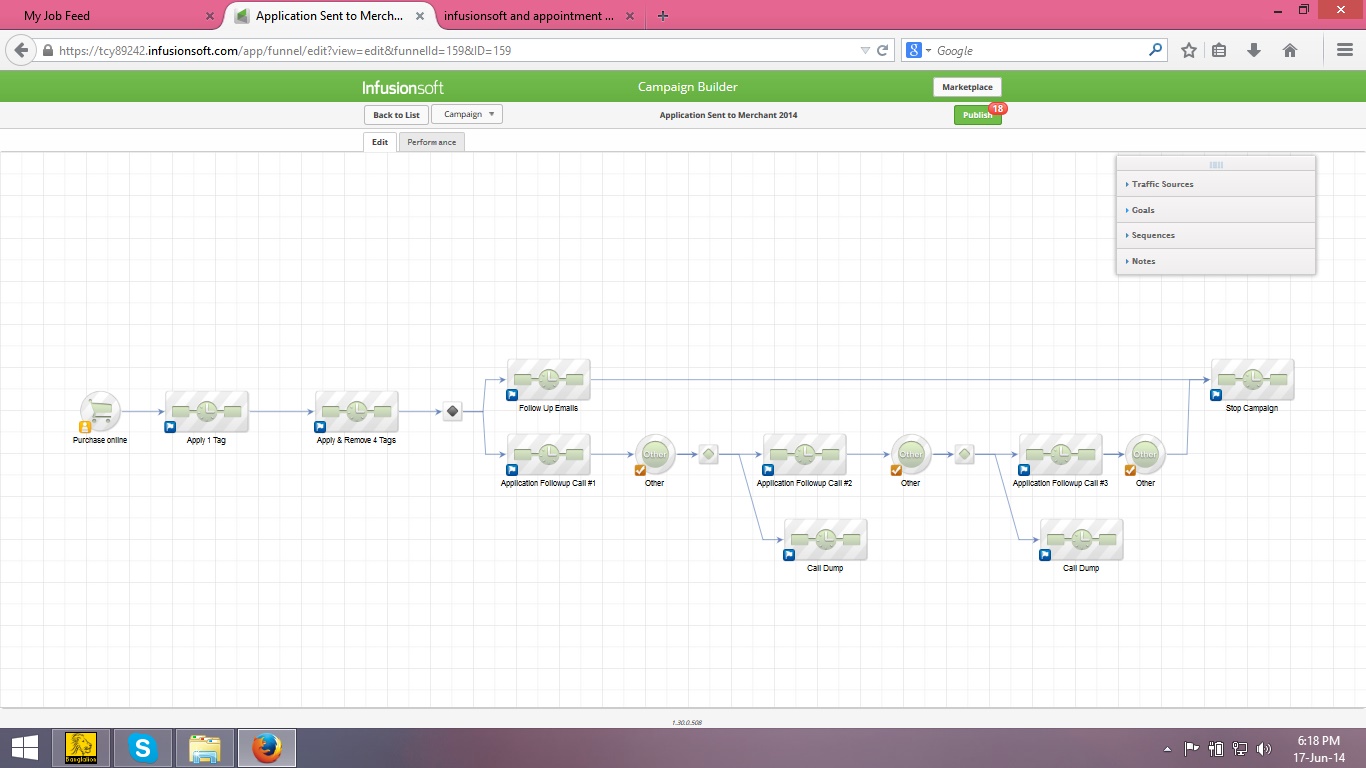
Application sent to merchant
What it produced
A process that runs on triggers rather than on memory.
The measurable version of that is what did not happen: applications no longer sat unactioned because somebody had a busy week, and follow up no longer depended on a person keeping a mental list.
No conversion or volume figures were measured on this engagement, so none are claimed. What changed is structural and it is visible in the work: applications advanced on triggers rather than on somebody having a spare hour.
Chris Swift describes this project in his own words, and it is worth more than anything I could write about it.
I'd like to tell anyone reading this letter to get rid of any reservations or concerns you might have and hire Zahurul because he does excellent work. I'm a fairly new oDesk user from USA and like you, I was very reluctant to hire somebody using this platform. I think I lucked out when I found Zahurul.
I've been a long time Infusionsoft user who started on the Legacy platform. I've been wanting to convert to the campaign builder but just never found the time to do it. Finally I decided it was time and that I couldn't do it myself.
Zahurul has done tremendous things to help me build new campaigns. He's very enthusiastic and has a great work ethic. His communication skills are fantastic and he will adapt his work schedule to yours. I know many Infusionsoft users who need help and Zahurul will be the first person I send them to. He's been a great asset to NoblePay and I will continue to hire Zahurul for my projects.
Chris Swift, founder and owner, NoblePay
Two things in that are worth separating out.
He had been putting the migration off. Infusionsoft Legacy to the campaign builder is not a small job and it is the kind of thing that stays on a list for years, because the business runs on the thing being migrated.
And he opens by saying he was reluctant to hire this way at all. That is the objection most people have and do not voice, stated by somebody who had it and hired anyway.
What applies to a business like yours
Three questions worth asking if you sell through applications or inquiries:
- When somebody submits an application, what happens in the next hour without anybody doing anything?
- Can your system tell the difference between an applicant waiting on you and one you are waiting on?
- Does your sales team work from a task list the system builds, or from a list they keep themselves?
The third question is where most inquiries are quietly lost.
Services behind this project
The thinking behind this project: The best automation ends with a human, not an email
Applications Are Not Lost On Purpose
Applications do not get lost because somebody decided to lose them. They get lost in the days between a system capturing something and a person getting to it.