
Two Campaigns, Same Year. The Cheaper One Did Better.
Your Parenting Mojo
1,116 sales at $5.90 of ad spend each, then a better return on a quarter of the budget
- Offer
- $27 cohort course
- Ad spend
- $6,586
- Sales
- 1,116
- Revenue
- $30,132
- Ad cost per sale
- $5.90
- Blended return
- 4.57x
- Client
- Your Parenting Mojo, founded by Jen Lumanlan
- Vertical
- Parenting education
- Period
- Two cohort intakes across 2021, roughly one month each
- Audiences
- Lookalikes, webinar attendees and related segments
- Work
- Ad creative, ad copy, campaign build, plus the Ontraport funnels underneath
- My role
- Direct client. Creative, copy, campaign setup and optimization
A $27 product, a fixed window, and no margin for error
Your Parenting Mojo is a parenting education business built on research rather than opinion, founded by Jen Lumanlan, with an audience that came in through a podcast and years of evidence based content. That audience is skeptical by disposition. They are why the business exists and they are also harder to sell to, because they check things.
The courses run as cohorts. The campaign is not an evergreen funnel that trickles. It has an open date, a close date, and whatever it produces inside that window is what it produces.
Before either campaign ran, I had already built the Ontraport sales funnels, fixed the website and set up the automation behind them, so the ads pointed at a system I had built rather than one I was handed.
Two things made this harder than a standard campaign.
At $27, the arithmetic is unforgiving. A high ticket course can absorb a $200 cost per sale and still work. At $27, a $30 cost per sale means paying to give the course away. The whole campaign has to run inside a margin most media buyers would call impossible, which is why low ticket products get declared unadvertisable and left to organic reach.
And the standard next step after a campaign that works is to spend more. On a cohort launch that is usually wrong. A cohort has a fixed window and a finite audience. The people who would buy the second course are largely the same people who saw the first. Spending five times as much does not reach five times as many suitable buyers.
What I built
- Ad creative and ad copy for both
Produced from the same research as the pages they pointed at. The promise in the ad and the promise on the page were the same promise, because one person wrote both. On a $27 product there is no margin to absorb a click that lands on a page saying something slightly different.
- Audience strategy
Lookalikes built from existing buyers, webinar attendee segments, and related warm audiences. At this price point there is no room to pay for discovery, so the campaigns leaned on audiences with a signal already attached rather than broad cold targeting.
- Campaign setup and structure
Full account build for each: campaigns, ad sets, creative rotation and the testing approach inside each cohort window.
- A second campaign built on what the first one taught
Taming Your Triggers began where Setting Limits finished. Audience selection and structure carried forward, narrowed by what had actually converted rather than broadened to chase volume. The creative could not be recycled, because it addresses a different parenting problem for the same people, but the targeting knowledge could.
- The funnel underneath both
Ontraport sales funnels and the automation behind them, built before either campaign ran, so traffic arrived at a path that already worked rather than at a page assembled for the launch.
- Optimization against sales, not clicks
A one month cohort gives no time for slow learning. Decisions ran against purchases from the first days.
What it produced
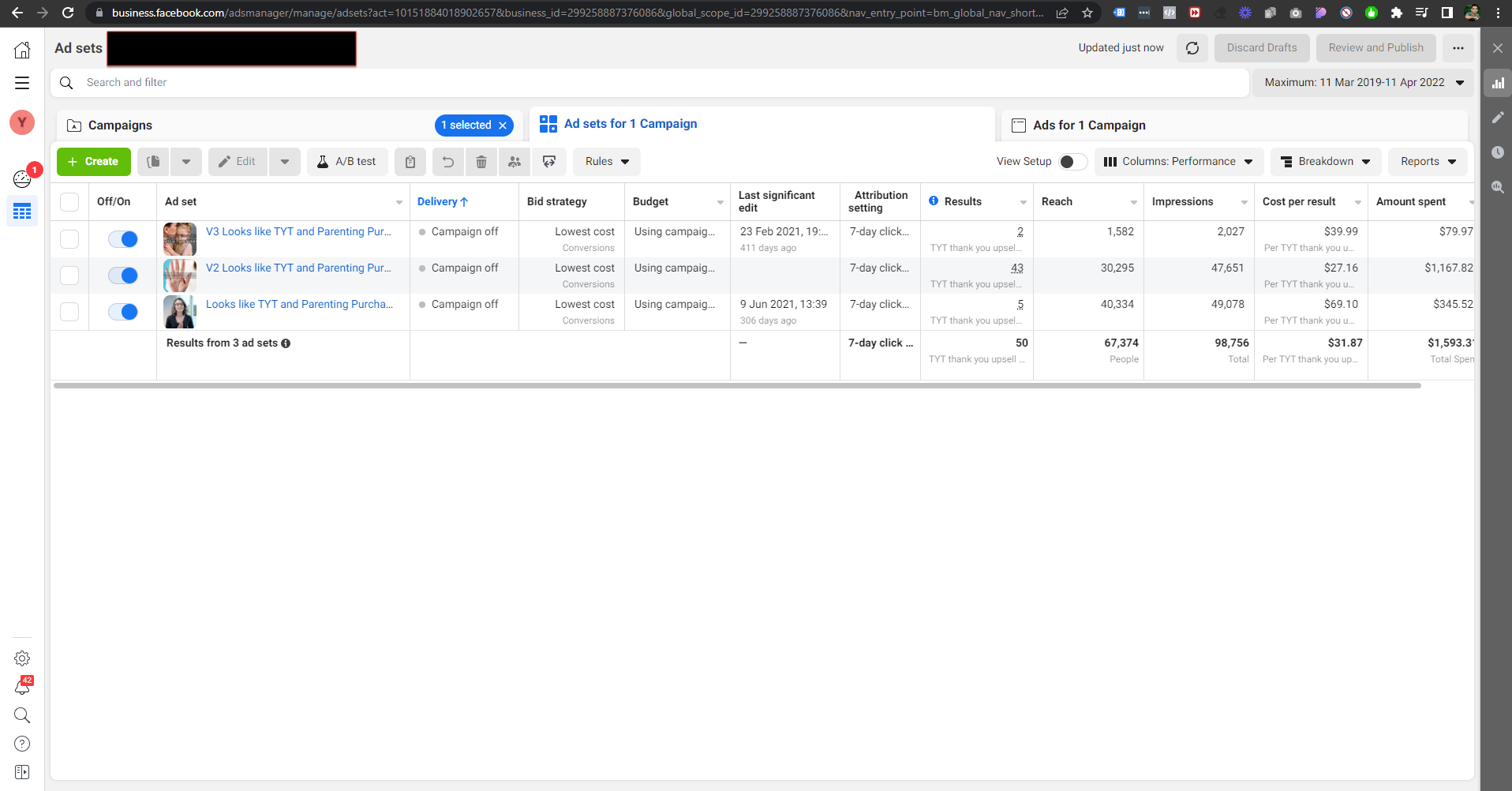
TYT Sales Ads
Setting Limits
| Ad spend | $6,586 |
| Sales | 1,116 |
| Revenue | $30,132 |
| Ad cost per sale | $5.90 |
| Ad spend as a share of revenue | 22% |
Taming Your Triggers
| Ad spend | $1,593 |
| Revenue | $9,850 |
| Blended return | 6.18x |
A quarter of the spend, a third of the revenue, and a better return on every dollar.
A note on how to read the returns. Both revenue figures are total course revenue for the cohort, not platform attributed revenue. Your Parenting Mojo has a podcast audience and an email list, and some buyers would have arrived without the campaigns. Both figures are blended, and strict attributed ROAS would be lower for each.
Stating that is more useful than quoting the bigger numbers. What is defensible is the shape: 1,116 people bought a $27 course inside a month at $5.90 of ad spend each, and the following campaign returned more per dollar on a quarter of the budget.
What applies to a business like yours
Three questions worth asking before your next campaign:
- If you clicked your own ad right now, would the page open with the same promise the ad made?
- Do you know your ad cost per sale, or only your cost per lead?
- Is your next budget set by what the last campaign taught you, or by what you spent last time plus a bit?
The second question is the one that decides whether a low ticket campaign is profitable or just busy.
Services behind this project
The thinking behind this project: The second campaign should usually be cheaper than the first
The Second Campaign Knew Something The First One Paid For
Eleven hundred people bought a $27 course in a month at under six dollars of ad spend each. Then the next campaign did better on a quarter of the budget, because by then the account knew who it was talking to.