
The Second Campaign Should Usually Be Cheaper Than The First
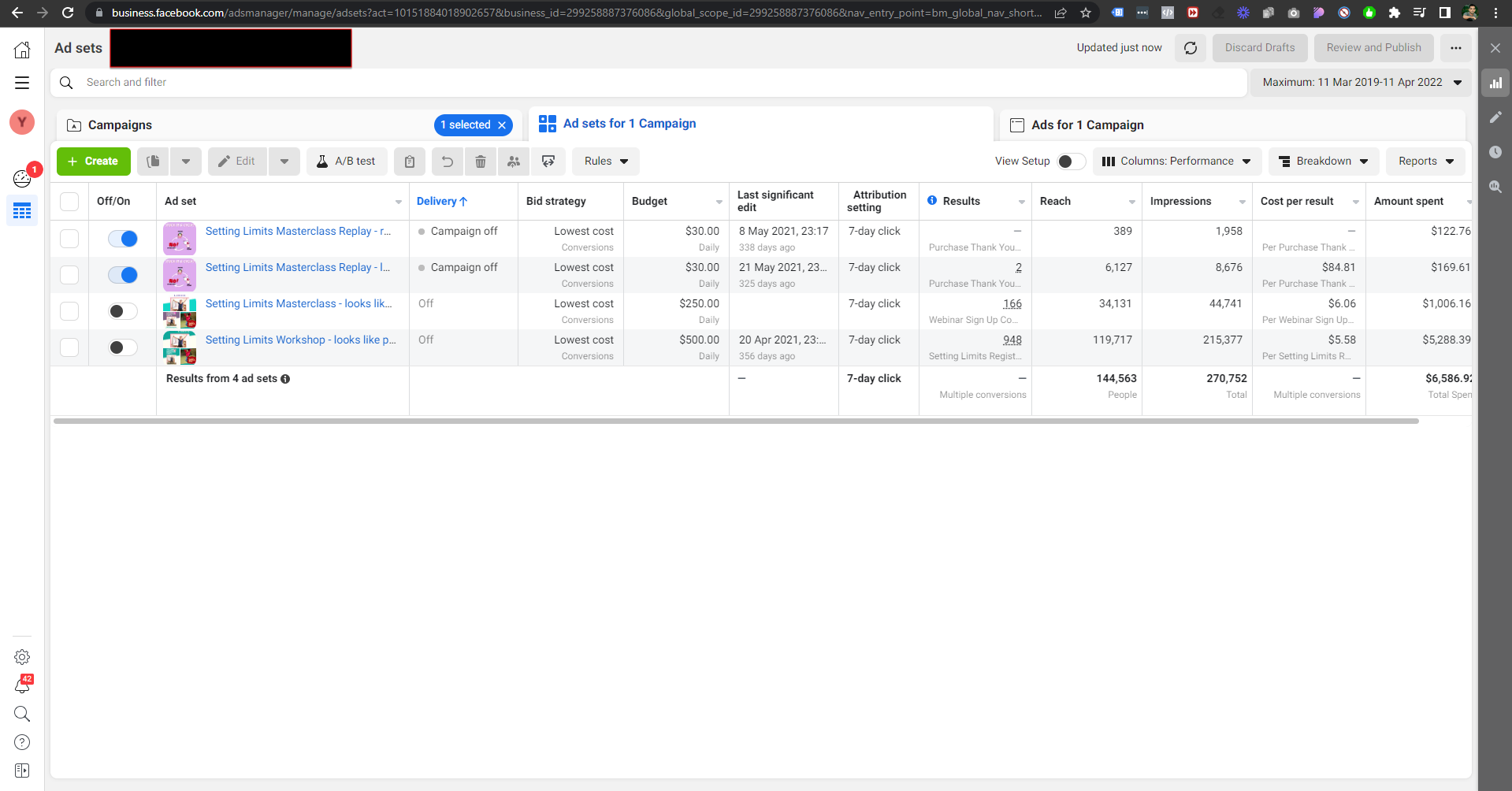
The first campaign spent $6,586 and returned 4.57 times.
The second spent $1,593 and returned 6.18 times.
Same business, same year, same audience base. The cheaper campaign performed better per dollar, and the reason is not that anybody got lucky.
Why does scaling ad spend usually reduce returns?
Some of it is unavoidable. Reaching more people means reaching worse fitting ones, and the best prospects are always reached first.
But a lot of it is a decision nobody examined. The default after a campaign works is to increase the budget, because the alternative feels like going backwards. Nobody proposes spending less on something that just succeeded.
On a fixed window cohort launch, that default is particularly costly. A cohort has an open date, a close date and a finite audience. The people who would buy the second course are largely the same people who saw the first. Spending five times as much does not reach five times as many suitable buyers. It reaches the same suitable buyers more often, then starts paying to reach unsuitable ones.
The extra reach has nowhere useful to go.
What did the two campaigns actually produce?
Your Parenting Mojo is a parenting education business built on research rather than opinion, founded by Jen Lumanlan, selling courses as cohorts with fixed intake windows.
| Setting Limits | Taming Your Triggers | |
|---|---|---|
| Ad spend | $6,586 | $1,593 |
| Sales | 1,116 | — |
| Revenue | $30,132 | $9,850 |
| Ad cost per sale | $5.90 | — |
| Blended return | 4.57x | 6.18x |
A quarter of the spend, a third of the revenue, and a better return on every dollar.
On how to read those returns. Both revenue figures are total course revenue for the cohort, not platform attributed revenue. The business has a podcast audience and an email list, and some buyers would have arrived without the campaigns. Both figures are blended, and a strict attributed ROAS would be lower for each.
That is worth stating rather than quoting the larger number. What is defensible is the shape of it.
What changed between the two campaigns?
Knowledge, mostly.
After the first campaign, the account knew things it could not have known before. Which lookalike audiences converted. Which webinar attendee segments responded. Which creative angles produced sales rather than clicks.
Spending that knowledge on a bigger budget wastes it, because a larger budget forces you back out into audiences you have no signal on. Spending it on a tighter one converts it into return.
The creative could not be recycled, because the second course addresses a different parenting problem for the same people. The targeting knowledge could.
So the question on a second campaign is not how much more to spend. It is how much less you can spend now that you know something.
Can you advertise a $27 product profitably?
Not the way you would advertise a $2,000 one, which is why people say you cannot.
A high ticket course absorbs a $200 cost per sale and still works. At $27, a $30 cost per sale means paying to give the course away. Broad cold targeting, a discovery budget and slow optimization all assume a margin that does not exist.
What works instead is unglamorous. Audiences with a signal already in them rather than cold prospecting. Creative and landing page written together, from the same research, so no click is wasted on a mismatch. Optimization against purchases from the first week, because there is no second month to correct in.
On Setting Limits that produced 1,116 sales at $5.90 of ad spend each, which is around 22% of revenue going to ads. That is a workable number on a low ticket cohort.
The constraint is real. It is a constraint on method, not a reason to leave the channel alone.
Does this apply to evergreen funnels too?
Less directly, and the difference is worth understanding.
An evergreen funnel has no fixed window and no finite intake, so additional reach does have somewhere to go. Scaling spend on evergreen usually does mean reaching more people who can still buy, and the diminishing returns arrive later.
Cohorts are the sharper case because the ceiling is structural rather than gradual. But the underlying point holds either way: the first campaign is the thing you pay for the data, and the second is the thing that spends it. Treating both as budget decisions rather than the first as an investment in knowing something is how accounts end up scaling into worse audiences.
How do I set the budget for my next campaign?
Three questions, and the third one gives you a number.
1. What did your last campaign teach you about who actually buys, and is that written down anywhere?
If the answer lives in somebody's head, it will not survive to the next campaign.
2. Is your next budget set by what you learned, or by what you spent last time plus a bit?
The second is the default and it is rarely examined.
3. If your offer runs in cohorts, how many people in your audience could realistically buy it?
That number is the ceiling. Budget above it is buying reach that has nowhere to go.
Spending Less After Something Works
The first campaign bought the audience data. The second one spent it, on a quarter of the budget, and did better per dollar for exactly that reason.
Spending less after something works is counterintuitive, which is why almost nobody does it.
If your last campaign worked and the next one is simply going to be bigger, that is worth a conversation before the budget is set.