
Attendance Went From 10% To 25% Without One Extra Registration
Kim Wellness
Attendance from 10% to 25%
- Client
- Kim Wellness
- Vertical
- Health and wellness
- Before
- 10% attendance, on two emails: a confirmation and one on the day
- After
- 25% webinar attendance rate
- Change
- Two and a half times the attendance on the same registrations
- Scale
- 2,000+ registrations per webinar
- Stack
- ActiveCampaign, Zoom, Zapier
- Work
- Webinar automation, reminder sequences, attendance tracking and follow up
- My role
- Direct client
Everybody counts registrations. Almost nobody counts attendance.
A webinar has two conversion points before anybody is sold anything. Somebody has to register, and then somebody has to show up.
The first one gets all the attention. Registration numbers appear in every report, they respond to obvious levers, and they feel like progress.
The second one is where the money actually is, and it is barely measured. Kim Wellness was filling webinars with over two thousand registrations each and losing nine out of every ten of those people before the session started. That is not unusual. It is what happens by default.
Doubling registrations doubles the acquisition cost. Improving attendance costs almost nothing and works on people who have already put their hand up.
The reason attendance goes unmanaged is that the gap between registering and attending is invisible. Nothing happens in it by default. Somebody signs up on Tuesday for a Thursday session and then lives their life, and by Thursday the session is a calendar entry competing with everything else in their day.
What was running before was two emails. A confirmation when somebody registered, and one on the day of the webinar.
That is not a reminder sequence. It is an acknowledgment and a notification, with a gap of days or weeks between them where nothing happens at all.
Somebody registers on a Tuesday for a session two weeks away. They hear nothing for thirteen days. By the time the day-of email arrives, the thing they signed up for has become a calendar entry competing with everything else in their afternoon, and they have no relationship with it beyond a form they filled in a fortnight ago.
Nine out of ten of them did not show up. That is what two emails produces, and it is what most businesses are running.
What I built
- Ten touchpoints across the gap, instead of two
When What On registration Confirmation 14 days before Email 7 days before Email 1 day before Email 12 hours before Email 6 hours before Email 1 hour before Email and SMS 30 minutes before Email 5 minutes before Email and SMS As the session starts SMS The shape matters as much as the count. Spaced out early, tightening as the session approaches, and switching to SMS at the end where email will not be checked in time.
The last three are the ones that move attendance most, because the failure is rarely that somebody forgot they registered. It is that they were doing something else when it started.
- Zoom, ActiveCampaign and Zapier connected
Registration in one system, contact record in another, session delivery in a third. Zapier carrying the data between them so a registrant existed everywhere at once rather than being copied by a person.
- Attendance recorded back into the CRM
The piece that makes the rest possible. Once attendance is a field on a contact record rather than a number trapped in the webinar platform, everything downstream can react to it: who attended, who registered and missed, who left early.
Without that, follow up after a webinar goes to everyone identically, which means the person who watched the whole session and the person who never turned up receive the same email.
- Follow up segmented by what actually happened
After the session, people were split by three things: whether they attended, what percentage they watched, and whether they bought.
Each segment got its own sequence of three to five emails. Somebody who watched to the end and did not buy is a different conversation from somebody who left at minute fifteen, and both are different from somebody who purchased.
- A separate sequence for the people who missed it
Anybody who registered and did not attend was routed to the replay rather than dropped. That is a meaningful share of the list on any webinar, and on most businesses they receive nothing at all.
The system, drawn
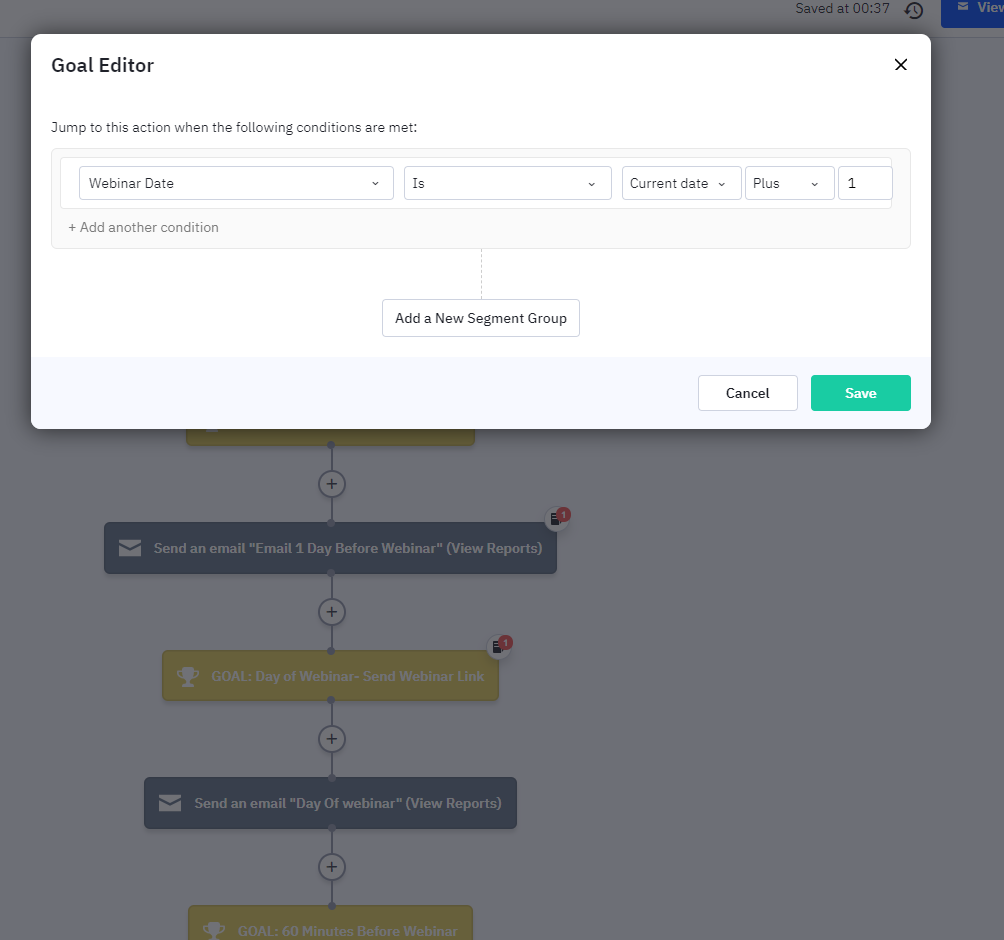
Automation workflow
What it produced
Attendance went from 10% to 25%.
On 2,000+ registrations per webinar, that is roughly 200 people in the room becoming roughly 500. Three hundred more attendees per session, on the same registrations, from the same traffic, at no additional acquisition cost.
The scale is also why the problem had survived. Two hundred attendees is a good-sized room. It looks like a working webinar, and nobody examines a number that looks fine. A big number that is also a small percentage does not feel like a leak, which is exactly what it was.
The second outcome is less visible and worth as much. Attendance became a number the business could see and act on. Before this, the webinar platform knew who attended and nothing else did.
What applies to a business like yours
Three questions worth asking about your own webinars:
- What is your show up rate? If the answer takes more than a minute to find, that is the answer
- How many messages does a registrant receive between signing up and the session starting?
- After the session, does somebody who watched the whole thing receive the same follow up as somebody who never turned up?
The first question is the one most businesses cannot answer, which is why the second and third go unaddressed.
Services behind this project
The thinking behind this project: Webinars do not work for my audience is usually a build problem
Registering Is Marketing. Turning Up Is A Sequence.
Getting somebody to register is marketing. Getting them to turn up is a sequence, and it costs almost nothing compared with acquiring them twice.