
Two Products, And Nobody Was Ever Offered The Second One
Kim Schaper
8 to 9% of buyers took the second product
- Client
- Kim Schaper
- Vertical
- Fitness courses
- Products
- SHRED at $27 a month or $197 a year, and The Metabolic Reset Method at $297
- Before
- Fractured website, fractured automation, membership access granted manually
- Built
- Offer architecture, positioning, story, website content structure, funnel, Ontraport automation and the course delivery structure
- Engagement
- Three months. Built in six weeks, then optimized
- Before
- One product sold at a time. No upsell path existed
- Result
- 8 to 9% of buyers took the second product
- Stack
- WordPress, Ontraport
- My role
- Direct client. Strategy through to build. The architecture was mine, not a brief I was handed
Two products that did not know about each other
Kim Schaper sells two fitness products. SHRED, a membership at $27 a month or $197 a year. The Metabolic Reset Method, a course at $297.
Two products is where automation stops being simple.
With one product the problem is easy. Somebody arrives, gets nurtured, buys or does not. Add a second and every question multiplies. Does a SHRED member get sold the course? What about somebody who bought the course and never joined the membership? What if they have both?
What existed was fractured on both sides. The website was scattered rather than built as a path. The automation was scattered in the same way, a set of pieces that fired without knowing about each other. And membership access was being granted manually, which is the detail that tells you how the rest of it worked: somebody was doing by hand a thing that should have happened the moment a payment cleared.
The cost of that is not the manual work, though the manual work is real. It is that a business with two products and no connection between them is selling each customer once, when almost every one of them is a candidate for both.
What I built
- The offer architecture
Which product comes first for which buyer, in which direction the cross-sell runs, and what somebody who owns both should stop being shown. A $27 monthly membership and a $297 course are not obviously ordered, and getting that wrong means either selling the cheaper thing to somebody who was ready for the expensive one, or the reverse.
- Positioning, value proposition and story
What each product is actually for, who it is for, and why somebody would choose it over the enormous amount of fitness content available for nothing. In a category this crowded, the claim and the story around it decide whether anybody reads the offer at all.
- Website content structure
Not just how the pages are built, but what goes on them and in what order. Which page carries which argument, where the cross-sell sits, what a visitor reads before they reach a price.
- Backend automation strategy
Designed before it was built. What triggers what, which buyer state produces which sequence, and what stops when somebody owns both products. Automation designed at the end of a project is a set of workarounds; designed at the start it is the structure everything else hangs on.
- Course delivery structure
How the material is organized and released, which is a marketing decision as much as an educational one. Completion drives renewal, and renewal drives whether a $27 membership is worth having at all.
That is the full scope, and it is worth stating because most of it is invisible in the finished product. Somebody looking at the site sees pages. The pages are the last thing that happened.
- The website rebuilt as a funnel
Not a site with funnels attached. The site itself structured as the path, so somebody arriving on any page has somewhere specific to go next.
- Ontraport automation across every product
Not one sequence per product built in isolation. A system where what somebody owns decides what they see, across the whole catalog at once.
- Each product upselling the other
Buy SHRED and the system offers the Metabolic Reset Method. Buy the course and it offers the membership. Both directions, automatically, at the moment after purchase when somebody is most likely to say yes again.
That is the mechanism behind the result at the bottom of this page. Not more traffic and not a price increase. The same customers, offered the second thing at the right moment.
- Automatic membership access
Payment clears, access is granted, nobody does anything. Small, unglamorous, and it removes a recurring manual task that was also a delay between somebody paying and somebody getting what they paid for.
- Segmentation across the full customer journey
Somebody's state held once and used everywhere, rather than reconstructed by each sequence separately.
The system, drawn
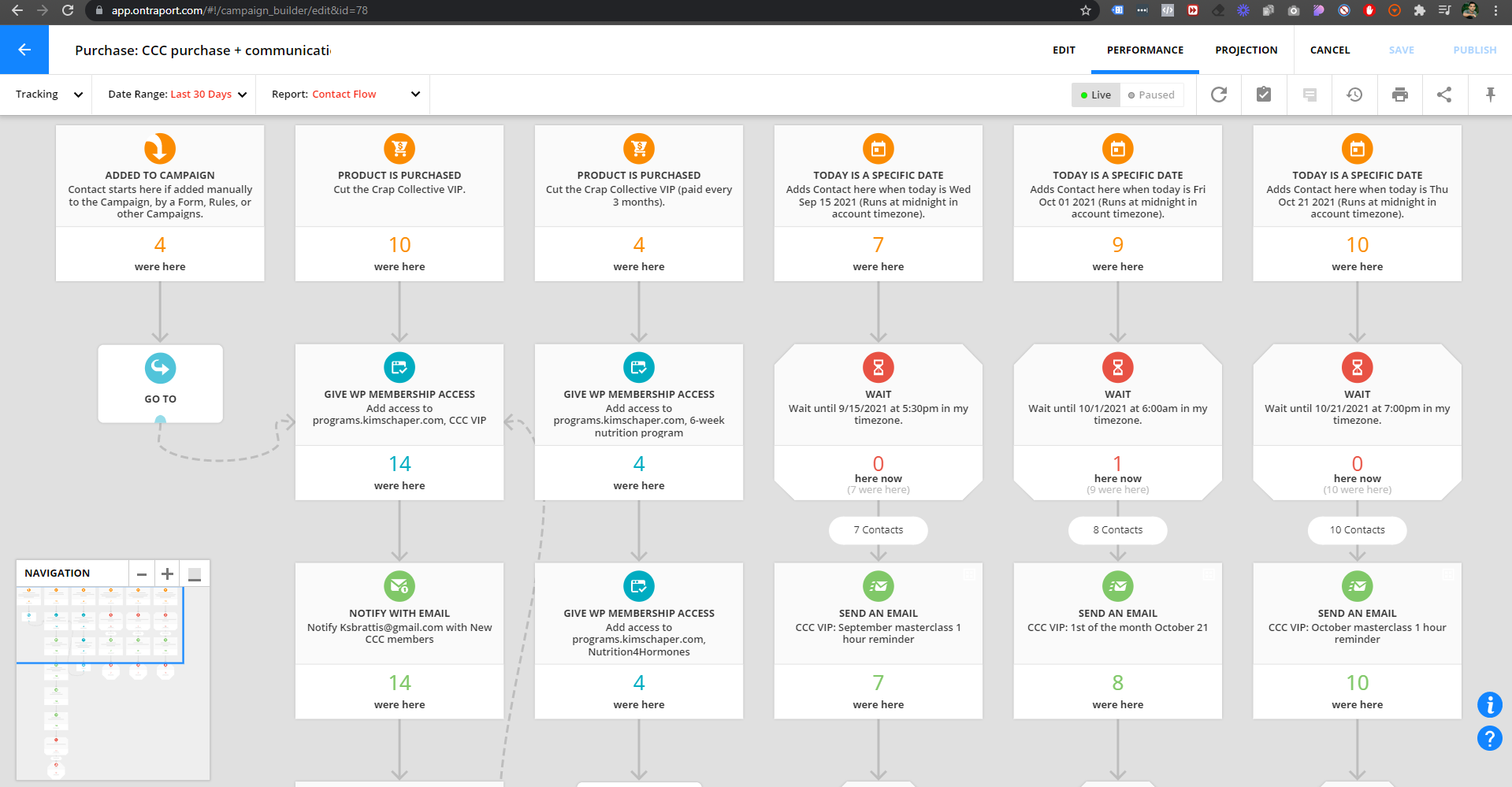
Course automation
What it produced
Between 8 and 9% of buyers took the second product.
Before this, that number was zero. Not low, zero. Each product was sold on its own and there was no mechanism for a buyer of one to be offered the other, so nobody ever was.
That is what the figure describes: not a lift on existing behavior, but the creation of behavior that did not previously exist.
The build took about six weeks. The remainder of the three months was spent optimizing it, which is when the take rate settled where it did.
The practical result is the one every multi product business wants and few have. Nobody gets sold something they already bought, membership access happens the moment a payment clears, and every buyer of one product is a live candidate for the other.
What applies to a business like yours
Three questions worth asking if you sell more than one thing:
- If somebody buys product A, does the sequence for product B know about it?
- How many emails could one customer receive from you in a week if they happened to be in every sequence at once?
- Is somebody's buyer state held in one place, or worked out separately by each campaign?
The second question is worth actually calculating. The answer surprises people.
Services behind this project
The thinking behind this project: Your front end offer is not where the money is
The Invisible Cost Of A Second Offer
Adding a product is easy. Making the rest of the system understand that the product now exists is the part nobody budgets for.