
There Was No Website. Just A Page.
Dirigo Food Safety
Five course sales: four at $1,500 and one at $2,997
- Client
- Dirigo Food Safety
- Vertical
- Food science and safety training
- Offers
- A $2,997 course with a monthly plan, and a $1,500 course
- Before
- No website. One scattered Kartra landing page, no segmentation, no campaigns
- Built
- Strategy, website, funnels, integrations, lead magnet and paid campaigns
- Engagement
- Three months
- Result
- Five course sales: four at $1,500 and one at $2,997
- Stack
- Kajabi, Kartra, Zapier
- Buyers
- Restaurants and food businesses that need certification
- My role
- Direct client. Strategy, design, copy, build and integration
A scattered page and nothing behind it
Dirigo Food Safety sells HACCP certification and food safety training to restaurants and food businesses. High ticket: a $2,997 course with a monthly payment plan alongside it, and a $1,500 course.
What existed was one landing page on Kartra. Scattered, in the sense that nothing on it led anywhere in particular.
There was no website. No structured path from somebody arriving to somebody buying. No contact segmentation, so everybody who came in was treated identically regardless of what they had done. No targeted campaigns, because there was nothing to target with. Nothing that would sell while nobody was watching.
At $1,500 and $2,997 that is a serious problem. A high ticket purchase is a considered one, and a considered purchase needs somewhere to be considered. A single page gives somebody one moment to decide, in a category where nobody decides in one moment.
The stack question came next, and it is the part worth reading if you are choosing platforms yourself.
What I built
- Strategy first, and the platform decisions came out of it
The offers, the buyer, the journey and the sequence of what to build, agreed before anything was bought or made. That is the order that makes the rest of this list coherent rather than accidental.
- A website, which did not previously exist
Built to carry the credibility a $2,997 decision needs, and to be the thing the funnels sit on rather than a brochure beside them.
- Lead magnet and paid campaigns
Ads to a lead magnet, lead magnet to an appointment booking, appointment to a conversation. On a high ticket course sold to business owners, that path exists because nobody buys a $2,997 certification program from an advert.
- Two platforms, each doing the thing it is actually good at
Kajabi hosts the courses. Kartra runs the funnels. That split was deliberate and it comes from a specific limitation in each.
Kajabi's page design is constrained. It was constrained then and it still is. For a course platform that is a reasonable trade, but it means the sales pages you can build on it are limited in ways that matter when the page has to do the selling.
Kartra's course hosting is poor. Good funnels, weak delivery. Running the courses there would have solved a page design problem by creating a worse student experience problem.
So each platform does the half it is genuinely better at. That costs two subscriptions and an integration, and it buys pages that convert and a course experience that holds up. The alternative, forcing one platform to do both, means accepting a compromise in whichever half it handles badly, and that compromise lasts for as long as the business does.
Choosing one tool for everything is the default because it is simpler to administer. Simpler to administer is not the same as better, and on this build it would have cost more than it saved.
The website sits on Kajabi alongside the courses. Kartra carries the funnels only.
- Zapier connecting them
The integration layer between the two, so a buyer on one side existed on the other and nothing depended on a person moving records between platforms.
- Copy across the site and funnels
Written for a technical audience, where overclaiming is more damaging than underselling because the reader can tell.
- Contact segmentation and campaigns
Neither existed before. What somebody received started depending on what they had done rather than on nothing at all.
The page that was built
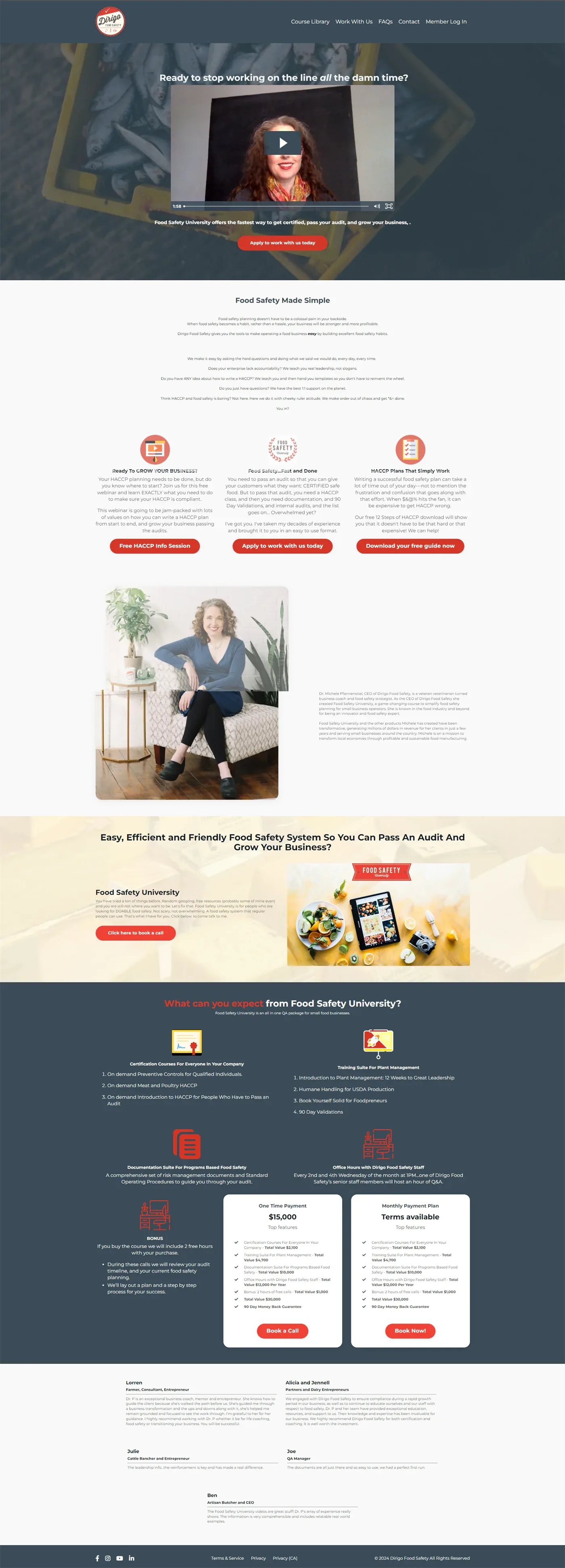
Website
What it produced
Five course sales inside the engagement: four at $1,500 and one at $2,997.
Around $9,000 from a business that three months earlier had one scattered landing page and no website.
The number is small and the shape is the point. These are considered purchases made by business owners who need certification, sold through a path that did not exist before: an advert, a lead magnet, a booked appointment, a conversation, a sale. Every step of that was built during the engagement.
What is defensible either way is the order it was done in. The plan came first, the platforms were chosen against it, and the integrations were designed rather than patched in when something did not reach somewhere it needed to be.
What applies to a business like yours
Three questions worth asking about your own stack:
- Could you explain why you are on each platform you pay for, or is the answer mostly historical?
- Is there a task somebody does every week that is really just moving data between two tools?
- If you added one more offer tomorrow, do you know where it would live and what would need connecting?
The second question usually has an answer nobody has costed.
Services behind this project
- Marketing strategy
- Website & sales funnel design
- Marketing automation
- Sales page and email copy
- Paid advertising
The thinking behind this project: The best automation ends with a human, not an email
Choose The Tools After You Know The Job
Nobody sets out to build a stack by accident. It happens one reasonable decision at a time, and then it is expensive to undo.