
Five Ad Platforms Feeding One Guide, Then The Funnel Splits
Lauren Dixon Photography
Implemented by others from the design, and reported back at 25% traffic to lead
- Client
- Lauren Dixon Photography
- Vertical
- Elopement and wedding photography
- Built
- Full marketing strategy, and the lead magnet funnel that was implemented from it
- Traffic sources
- Facebook, Instagram, Google, Pinterest and TikTok
- Funnel
- Elopement guide opt in, pricing and availability page, then branching follow up
- Stack
- ActiveCampaign
- Engagement
- One month
- Reported result
- 25% of traffic converted to a lead. 5% of those booked availability
- My role
- Direct client. Strategy and funnel design. Implementation was carried out by others
Photography sells on trust, and trust takes longer than a click
Elopement photography is booked months ahead, costs a meaningful amount, and is chosen almost entirely on whether somebody believes this photographer will capture the day the way they imagine it.
Nobody books that from an ad. They look, they save, they compare, they look again, and somewhere in that process they either commit or drift.
The drift is the problem. Not rejection, drift. Somebody sees the work, likes it, means to inquire, and does not. Six weeks later they book somebody who stayed in front of them.
So the funnel's job is not to convert on the first visit. It is to capture somebody at the point of interest and stay present through a decision that takes weeks.
That also means a single traffic source is not enough. A person planning an elopement is on Pinterest for inspiration, Instagram for photographers, Google when they get specific, and TikTok without meaning to be. Reaching them once on one platform is not reaching them.
She already had a website. What she did not have was growth, and she was not making sales through it.
The brief was not a funnel. It was a growth engine: a system that would produce bookings rather than a site that sat there. That is a strategy question before it is a build question, so the engagement started with research rather than with pages.
SWOT, competitive research, and the full journey mapped from first touch to booked session. Every stage specified, with what to measure at each one and what to change first when a number underperformed.
What I built
- Five traffic sources into one entry point
Facebook, Instagram, Google, Pinterest and TikTok, all pointing at the same elopement guide opt in page. One place to optimize rather than five landing pages drifting apart from each other.
- A lead magnet built for the actual decision
An elopement guide. Not a discount, not a checklist, but the thing somebody planning an elopement is genuinely looking for, which means the people who take it are the people who are planning one.
- Immediate welcome email, and a tagged list
The opt in adds the contact to a dedicated ActiveCampaign list and triggers a welcome email straight away, so the first contact happens while the interest is fresh rather than in a batch later.
- Pricing and availability page
The step after the guide. Somebody who has read it and is still interested reaches the two things they actually need to know: what it costs and whether the date is free.
- Retargeting from all five platforms after five days
Not immediately, and not never. Five days, on every platform they might be using, pointing back at the pricing and availability page rather than at the top of the funnel again. Somebody who has already opted in does not need the guide offered to them a second time.
- Two branches, depending on what happened
If they did not book, they enter an elopement follow up series: seven emails and two SMS messages, interleaved so the sequence has more than one way of reaching somebody over the weeks a decision like this takes.
If they did book, they enter a separate giveaway funnel offering 10% off. A booked client is the best audience the business has, and most photography funnels stop the moment somebody books.
- An optimization approach defined per stage
Beyond the build, the strategy specified what to measure at each step and what to change first when a number underperforms, so the plan could be run rather than only followed.
The system, drawn
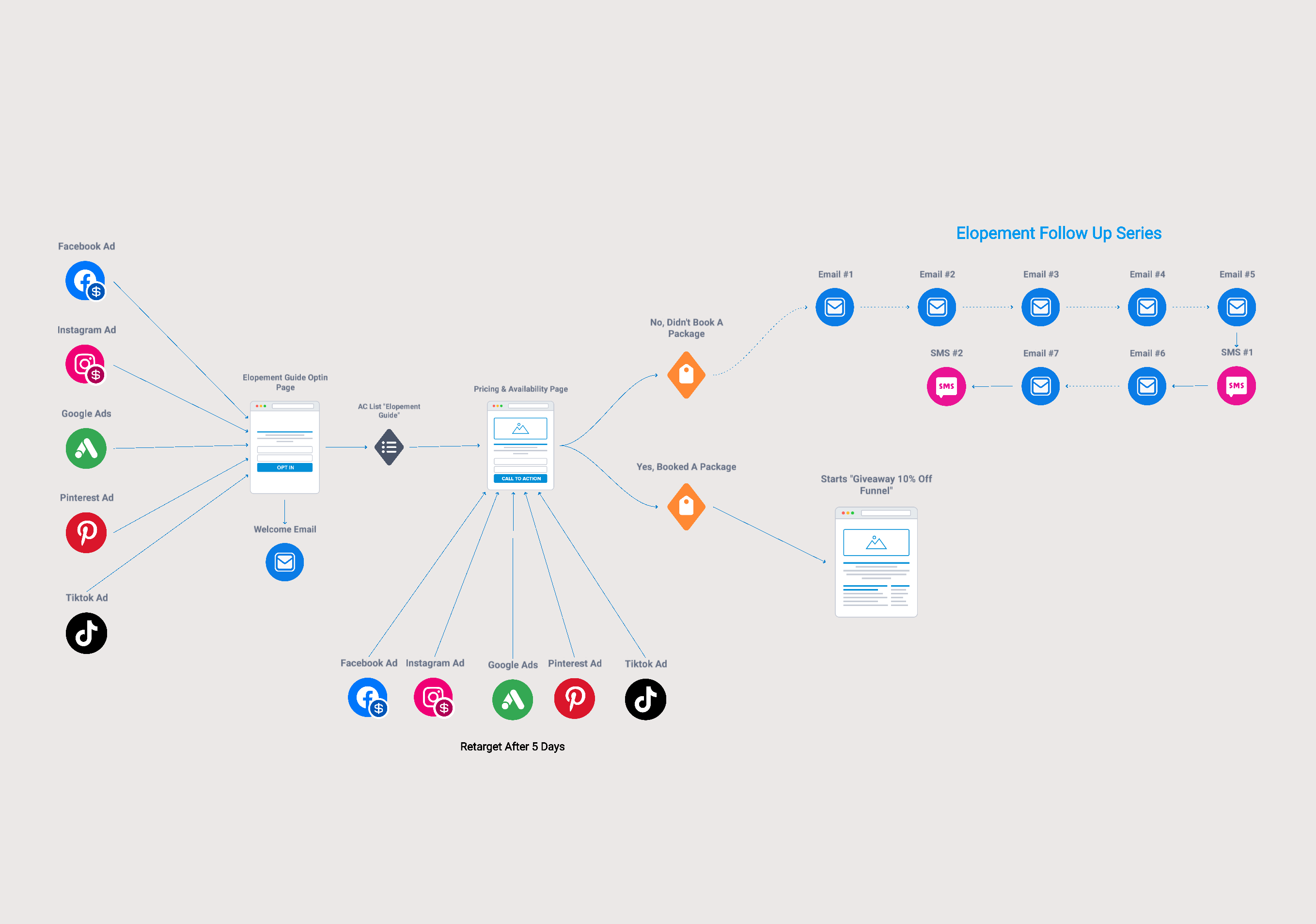
Marketing strategy flow
What it produced
A plan detailed enough that somebody else could execute it.
That is the outcome, and this page states it plainly rather than implying more.
The strategy was delivered in full: paid ads, the lead magnet, retargeting, booking funnels, and email and SMS follow up, with the optimization approach specified per stage. Most of it was not built, because the cost of the whole system was more than the business wanted to commit at that point.
The elopement guide funnel was built, from this design, by somebody else. I did not implement it.
What was reported back from it:
25% of traffic converted into a lead. One in four people who reached the guide page took it.
5% of those leads booked availability. One in twenty of the people who opted in.
Two things about those figures need saying. They come from what was reported to me rather than from an account I could see. And the build was not mine, so what they measure is a design executed by a third party rather than a system I delivered end to end.
Both of those weaken the claim and both are true. A 25% opt in rate is strong enough that it would be easy to leave the attribution vague, which is exactly why it is stated.
What applies to a business like yours
Three questions worth asking if you sell something booked months in advance:
- What happens to somebody who is interested now but deciding in six weeks?
- When you retarget, do you send people back to the top of the funnel or to the step they stopped at?
- Does anything happen after somebody books, or does the funnel end there?
The third question is where photographers, coaches and consultants all leave the same money on the table.
Services behind this project
The thinking behind this project: Your front end offer is not where the money is
Stay In Front Of Them For Six Weeks
Somebody planning an elopement is not rejecting you. They are deciding slowly, on five platforms, over several weeks, and the funnel either stays with them or it does not.